Authentic Business Planning
Module 1, “You're where you need to be”, free to watch for 72 hours.
Watch the replayGet the replay by email
About 58 minutes, in 5 short segments. You’ll have 72 hours from the moment you first open it. If you buy the course, this module comes with it, along with all the others, and you keep them for life.
Already signed up? Open the link in your welcome email.
Inside this module
- ✓Welcome 🤗
- ✓You're not "behind" 🙏🏼🧡
- ✓5 Levels of Soulpreneur Business.
- ✓Overview of The 7 Practices.
- ✓One Tiny Experiment.
What people said
“I loved the teaching on feeling “behind” – and what to do about it / how to relate to it.”
“This course is like a mini-MBA, useful for beginners or advanced. I particularly appreciate George’s emphasis on authenticity and making a real impact on people’s daily lives.”
“George Kao's work has delighted me. By sharing his expertise with disarming frankness and principled vulnerability, he helps the rest of us begin to discern what feels right for ourselves as we navigate being of service to others in a sustainable way.”
Your replay
Your replay is open until … (your time).
Two ways through this module
Use either one, or both. Each remembers your place.
Click on any of the options above.
0:00 of 57:57
Pick up where you left off: …
Module 1’s Lessons:
Welcome 🤗
Video · 4 min
Key points from the video
- This is roughly the 7th iteration of the Authentic Business Planning framework since George started teaching it in 2009; he calls it his best version yet.
- Frames himself as an iterative learner and creator who doesn't believe there's one single truth about business planning, at least not for everybody — hence the course is called Authentic Business Planning: take what's taught and modify it to your own goals/style; he's genuinely curious to see how students adapt it.
- Describes all his courses as learning communities: students co-create knowledge together, apply it, share their results, and learn together.
- Introduces the term "soulpreneur" (like a solopreneur, but bringing more of one's soulfulness to business) and leaves the fuller definition open for students to articulate in their own words.
- Previews the module ahead: the 5 Levels of Soulpreneur Growth, plus a first touch on the 7 Practices, which he has practiced himself and taught to clients for years.
The full lesson text (click to show)
Welcome! 😊
I'm so glad you're here.
Before we dive into the content, I want you to take a moment to feel the energy of this space...
Soulpreneurs just like you have gathered here—coaches, healers, artists, consultants, and heart-centered service providers. Each one is committed to doing work that brings more beauty, meaning, and upliftment to the world.
That's what makes the students of this course special. You're not surrounded by people chasing shortcuts or hype. You're alongside people who care deeply about the how of business, not just the results.
Take a breath and let that land. ✨
What you'll gain in this module:
- A simple map of the 5 Levels — so you can see the full landscape of business development for a soulpreneur, and locate yourself on it
- A clear picture of the 7 Practices — the core ways to grow an authentic business, so you know what's effective to focus on
- One small experiment — a doable action for the next 7 days that fits where you actually are
No overwhelm. Just clarity and one next step :)
A note on how we'll work together:
This definitely isn't about perfection, or pressure. It's about honest reflection and gentle/sustainable forward movement.
I'll share frameworks, but I invite you to feel into what resonates, and always feel welcome to bring your feedback/suggestions to my free monthly Q&A call. Your intuition matters here just as much as what's being taught "to" you.
Also, as you see fellow soulpreneurs comment in the Student Discussion doc, I hope you'll take a moment and reply to 2 others' comments for every one that you create. This keeps a healthy balance among the students of this course, and your replies will be encouraging for those commenters. Thank you!
Let's begin. 🙏🏼🧡
George's answers to students' questions (click to show)
A student shared: "I LOVE how easily you mention helping "hundreds of clients". I can say the same (I think), but I'm often flustered, or pause around these kinds of statistics. [Do I need to go back and count?] Maybe I think of it as a (potentially) flashy or egoic thing. And, what I get from your ease in mentioning that (not bragging) is that I can unhook from being so attached to any stats - that what I bring …"
George replied: an insightful noticing! Thank you for sharing this.
Talk about this lesson with other students in the Student Discussion doc.
You're not "behind" 🙏🏼🧡
Video · 7 min
Key points from the video
- Opens, before any teaching, by asking what triggers the feeling of being behind, and invites students to journal on it.
- Core insight: the only way to not feel behind is probably to have a boss who sets the deadline for you. As your own boss in self-employment, you decide what counts as "behind", and diligent, growth-oriented people (taking a course to improve is itself a sign of that) are probably more prone to the feeling.
- Notes that being enrolled in a structured program can itself trigger the feeling, such as being in week two without having finished week one. It's not the fault of the student or the teacher, since programs need some kind of sequence.
- He likes to remind solopreneurs that we must reparent ourselves, which is also the title of one of his blog posts. He frames entrepreneurship as one of the greatest stages, or methods, for personal development.
- His personal practice when he feels behind: the Energy Reboot — roughly 20–30 seconds of conscious breathing paired with mantras or values he is embodying — which reminds him that all is well and moves him into a more productive emotional state before he takes the next step. Acting from the feeling of being behind probably isn't helpful; better emotional and mental states are available.
- Closing frame: reframing "behind" isn't a one-time fix — he invites students to remember this the next time the feeling resurfaces, and to come back to it or do a practice.
The full lesson text (click to show)
Most of us feel behind.
Behind in numbers of followers... or income... or simply clarity about our business strategy and what we should be doing on a typical Tuesday afternoon when you're staring at your to-do list and nothing feels like the right priority.
If that resonates, you're not alone. It's a common feeling among soulpreneurs!
But let's reframe this—because feeling behind isn't helpful. It keeps us stuck in comparison and self-judgment, which drains the very energy we need to move forward.
The reframe:
You're right where you need to be.
I know that might sound like a platitude, but I mean it practically. Wherever you are in your business journey, that's your starting point. And a clear starting point is exactly what you need to move forward with focus instead of overwhelm.
The problem isn't that you're behind. The problem is that most business advice doesn't account for where you actually are. It throws strategies at you without helping you understand which ones fit your current situation.
That's what we're going to fix.
What's next:
In the next lesson, I'll introduce the 5 Levels of Soulpreneur Business Development—a simple map that shows you the full landscape of building an authentic business.
Once you can see the map and locate yourself on it, everything changes. You stop trying to do everything at once. You stop borrowing strategies meant for someone three levels ahead of you. And you finally know what to focus on—and what to let go of—right now.
Let's take a look at that map...
Feel free to share in the Student Discussion doc: Have you been feeling "behind"? What does that look like for you—comparison to a specific person? Pressure about a particular metric? Sometimes just naming it loosens its grip. 🙏🏼🧡
George's answers to students' questions (click to show)
A student shared: "Thank you for this replay George I so appreciate it. When I feel behind it's because there is a part of me that wishes I had all the systems already set up and in working order. I just have to come back to the remembering that I am right where I need to be. I am doing the best I can. I have all I need. My inner landscape is just as important as my business. Tending to my inner self is the …"
George replied: a lovely reframe! Thank you.
A student shared: "How might I reframe when I'm feeling behind: Self talk: I'm on my own path. My journey is unique to me. Feeling behind means that I want more. More out of life. More from myself. It's a reminder to stay on the path to a deeper expression of who I am. That there is potential to grow and learn. Also knowing that people who appear 'ahead of me' probably experience a sense that they are behind too."
George replied: so true! Everyone always had people "ahead of them" to compare to. And I love your reframing that feeling behind means you want more/potential.
A student shared: "Why I feel behind: I designed my life really well (or so I thouhght). Touring musician with tenure at a conservatory. Then the pandemic hit, I wasn't allowed to travel, and I knew I had to make radical changes. I dug into all my business skills (had a business/arts combo degree) and did a bunch of courses that promised 6 figures in 6 minutes bla bla. And thought ok, i'm ready to go. Then …"
George replied: you definitely got this! You have n extraordinary amount of talent, as well as awareness of people, and all the biz skills you've already developed. Looking forward to seeing you rock this year, even with caretaking needs 🧡
A student shared: "Thank you for this important mindset reframe I didn't know I needed, George! I did some quick stream-of-consciousness journaling on this and got that I mostly felt embarrased and guilty comparing my progress with others, and also for not implementing much from all the business courses I've taken, sometimes, repeatedly, for the past few years. I see that I've still been doing some spiral learning, …"
George replied: it's wonderful you already have tools to work with emotions like this!🧡
A student shared: "I love your framing the “behind” feeling as a call to stay for deeper expression. I think it’s easy to stay surface level in our culture, but deeper requires our own timing."
George replied: yes! allow, surrender, accept, trust. and hilarious gifs -- thank you 😄
A student shared: "As someone who is distinctly aware that my life (and my business) are my own unique journey, I do not have a sense of "being behind." But I do have a sense of "urgency" ... a sense of limited time to fulfill my quest to shine the light on what I want to contribute. And rather than living in the regrets of what I could have done, I am eager to accept and embrace the reality of where I am as my …"
George replied: urgency for legacy is good! And as you wrote, embracing the current starting point and moving forward without dwelling on regret🙏🏼
A student shared: "I'm a little "behind" in this course, so commenting now, ha ha! But I really appreciate you addressing this issue, because it is something I struggle with a lot. I have alternated between working on my business and then going back to work as a school teacher for the last ten years, always seeming to need to return to teaching when I don't make enough progress in the business. So, I have …"
George replied: I honor your resilience and continual return to your business! May this be your most successful journey and bring the freedom you seek 🙏🏼🧡
A student shared: "I think I rather have a feeling of "being late to the party" than being behind, does that make sense? I feel that I should have taken my business online much sooner, but of course that's also not true, because all the experience I gained teaching live have shaped the way I teach online. By now, I'm doing quite well, and still I have this feeling of being late to the party. I guess because some …"
George replied: welcome! I'm glad you're here.
As for feeling late to the party, your niche will continue getting more interest over the years I think, given the digitization of everything and increased value of offline experiences. I think you're going to be seen as a pioneer to many 😊
Talk about this lesson with other students in the Student Discussion doc.
5 Levels of Soulpreneur Business
Video · 21 min
Key points from the video
- History of the framework: it began as ten years of authentic business, became 10 levels, and was recently streamlined to 5 Levels, which he finds more doable and relevant.
- Critique of mainstream business advice: a lot of business consultants and experts learned marketing and strategic planning either in corporate jobs or through an MBA, so many of the strategies taught suit Level 4–5 businesses and fit Levels 1–2 (and maybe 3) poorly. When advice feels like a bad fit, it doesn't mean something is wrong with you; the strategy may simply belong to a different level than yours.
- Mountain-climbing metaphor for the journey framing of Level 1: like a climber, you prepare with equipment and the mindset that this is a long journey, not something finished in half an hour. Paired with a muscle-building metaphor: building muscle is sometimes painful and you won't always feel like working out, but once you get going you feel proud of yourself.
- Foundational definition of a market: it is what the people you can actually reach spend their money on, not some set of statistics out there. River metaphor: the market is a huge, always-flowing river of cash, so dip a ladle into the river instead of shouting about your modality from a mountaintop; bring it down to where people are already spending money.
- A sales secret he has learned over many years: if you're having a hard time getting clients, adjust what you sell. When you sell what people already want, they say yes easily, but if you have to change their beliefs about your modality, it takes much longer and much more effort (not impossible, though). Take what you offer and adjust it to what they want, which takes creativity.
- Level 1 (Foundation): muscle-building — content creation and market discovery conversations, without pressure for clarity on audience/message/offers yet; simply understanding people, not yet selling them.
- Level 2 (Experimentation): a "scientist mindset" — tracking what gets traction vs. crickets in content and in conversations, forming a working hypothesis about who you help and what you might offer.
- Level 3 (Validation): personal story — George's early clients were mostly women roughly 20 years older than him, nothing like his assumed "ideal client" (a same-age, MBA-holding male) — illustrating that fit can't be guessed, only discovered through serving different types of people and noticing who gets real results. By the end of Level 3 you ideally have a couple of case studies from clients.
- Level 4 (Integration/Systematization): everything from Levels 1–3 gets built into a repeatable system — a content cadence, an annual offer calendar tied to seasonal energy (for example, one offer in January and a different one in February, because each month has a different energy).
- Level 5 (Kaizen Forever): Japanese word for small, continuous improvements; refining systems, automating, outsourcing, and stepping back to see the bigger picture. You don't need a human team at Level 5: AI tools are getting savvy enough that AI agents can handle part of the work, so you can stay a solopreneur or build a human team. He has done both.
- Pivoting rule: a small pivot (same audience, new offer/niche) keeps your level. A big pivot (a genuinely different audience) sends you back to roughly Level 2, not Level 1 — you retain built muscle even if you must rebuild audience-specific traction.
- Closes by asking you to make an honest guess at which of the five levels you're at, with a more detailed assessment coming in Module 2.
- Per-level detail: Level 1 (Foundation) = "I'm starting to put myself out there, learning to work lightly!"; completion signal = creating/sharing without it feeling like a huge ordeal. Level 2 (Experimentation) = testing and noticing what resonates; completion signal = can state a working hypothesis ("Right now, I think I help [type of person] with [problem/desire] so they can [outcome]"). Level 3 (Validation) = first paying clients, real evidence of transformation. Level 4 (Systematization) = 2–3 core offers reliably bringing clients, solid case studies, building financial stability — this is where the actions of the 111 Formula are all complete. Level 5 (Kaizen) = can step away for extended breaks without everything falling apart. For deeper study of the full framework (specific actions/milestones per level): 5-Level Framework for Soulpreneur Business Growth.
The full lesson text (click to show)
Now that we've let go of the "behind" mindset, let's look at the map...
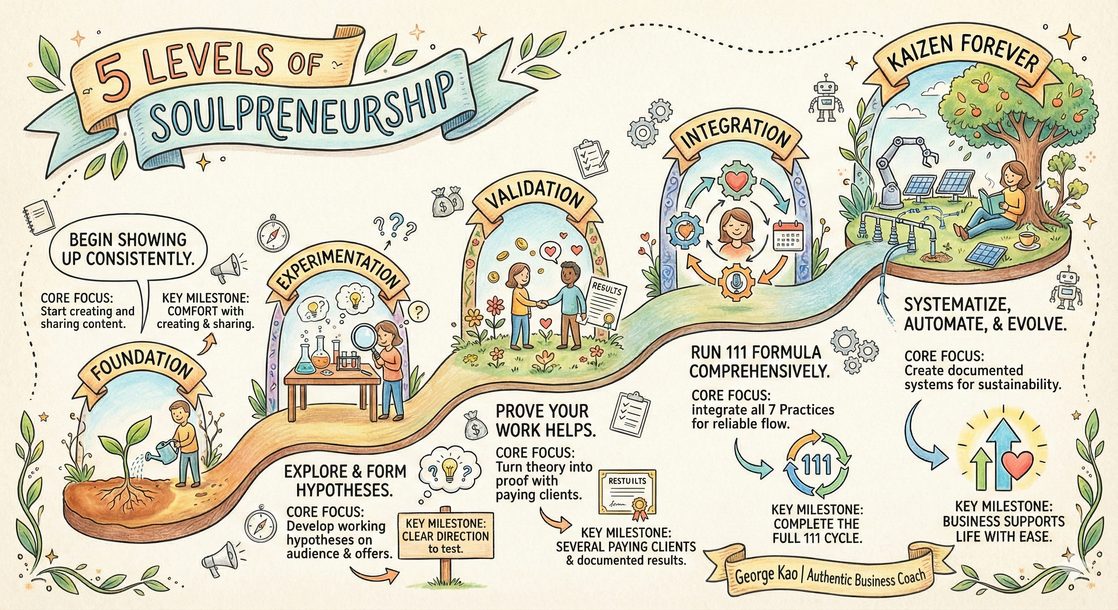
The 5 Levels of Soulpreneur Business Development give you a way to see where you are in your journey—right where you need to be. Each level has its own focus, its own challenges, and its own version of success.
There's no "better" level. Each one is important to experience and complete. Your job is simply to be honest about where you are, so you can stop trying to do everything at once and getting overwhelmed!
Let's walk through them...
Level 1: FoundationWhat it's about: Beginning to show up consistently with content and conversations. You're building basic creative and relational muscles—without pressure to have clarity on your audience, message, or offers yet.
Common feeling: "I'm not sure what I'm doing, but I'm starting to put myself out there, learning to work lightly!"
The complete this level: You can now create and share content without it feeling like a huge ordeal. Showing up is becoming more natural.
Level 2: ExperimentationWhat it's about: Exploring and forming working hypotheses. You're testing ideas, noticing what resonates, and starting to see patterns in who you help and what you might offer.
Common feeling: "I'm testing a variety things and paying attention to what works."
The complete this level: You can now articulate a working hypothesis—something like: "Right now, I think I help [type of person] with [problem/desire] so they can [outcome]."
Level 3: ValidationWhat it's about: Proving your work actually helps people who pay you. You're serving your first paying clients and gathering real evidence that your approach creates transformation.
Common feeling: "I'm getting traction. People are paying me—and it's working."
The complete this level: You now have several paying clients who have experienced clear results, and you've documented at least a few of those transformations.
Level 4: SystematizationWhat it's about: Running all the core business practices together consistently. You're no longer focus on experimentation—you're integrating the proven pieces into a reliable rhythm that generates steady client flow and income.
Common feeling: "I have a real business now. I know what works and I'm doing it consistently."
The complete this level: You now have 2-3 core offers that reliably bring in clients, solid case studies, and financial stability building.
The 111 Formula (Actions Complete by Level 4) –
It’s called the 111 Formula because the number of actions added together form 111:
- 40 Stage 1 Content Experiments (Authentic Content Creation): Test topics and formats to identify what resonates
- 20 Collaborations (Netcaring → Collabs): Simple exchanges like interviews, co-posts, or guest content
- 20 Market Discovery Conversations (Market Discovery → Aligned Offers): Listen deeply to potential clients' needs and desires
- 10 Stage 2 Content Pieces: Refine and redistribute your best Stage 1 content
- 10 Gentle Launches: Light, authentic invitations of your offers
- 6 Joyful Productivity Practices: Build personal energy management systems
- 5 Client Case Studies (Mastery of Craft) – Document client transformations and results
Level 5: KaizenWhat it's about: Systematizing, simplifying, and evolving. You're documenting your processes, automating what drains you, and creating a business that supports your life rather than consuming it.
Common feeling: "My business runs smoothly. I have space for rest, creativity, and contribution."
The settle in at this level: You can step away for extended breaks without everything falling apart. Your business is a long-term vehicle for meaningful work and a flourishing life.
A few things to notice:
- Each level builds on the previous one. You can't skip levels—but you can move through them at your own pace.
- The wins get bigger, but so does the foundation beneath you. That's why every level matters.
- Most soulpreneurs are somewhere between Levels 1-3. If that's you, you're in good company :)
Reflection:
Based on what you just read, write your best guess:
"I'm probably in Level ___."
Don't worry about getting it exactly right. We'll do a more detailed diagnosis in Modules 2. For now, just notice where you feel you are…
To get a preview of the details, see the 5 levels blog post.
Share your guess in the Student Discussion doc if you'd like! It can be helpful to name it—and encouraging to see where others are too. Try to reply to 2 others' comments for every one you create. Your encouragement means a lot to fellow soulpreneurs. 🙏🏼🧡
George's answers to students' questions (click to show)
A student shared: "I feel like I’m somewhere between level 4 and level 5. I have clients, I have a following on social media, I have many success stories, and I have several products. But I also feel like I’m getting stuck. I can’t seem to grow my email list beyond 3,000 subscribers. I get many sign-ups, but also many unsubscribes. And I feel like people don’t buy the same way anymore. It’s much harder for me to …"
George replied: thank you for sharing! I bet many 4/5s can relate. Technology has changed society and therefore the markets are looking for something different. For some of us (myself included) it's back to level 2 experimentation with niched offers. 🙏🏼
A student shared: "I feel I'm in level 3 but still attending to levels 1 and 2. I'm excited to ground my practice in level 3 and begin integrating in level 4 in the coming year. I love the graphic Can I share the visual with a link to your website?"
George replied: thank you! Yes feel free to share the visual. 🙏🏼
A student shared: "I believe I'm at level 3. I've been coaching for a long time (since 2008) - but, intentionally, at a "low simmer" - always doing some other primary work that is not this part of my business. I have some systems. I outsource some things already. But the main thing that puts me in the 3 realm is that I have clients who pay me regularly. What I'm working on / aiming for is more of them paying for my …"
George replied: great that you've already tested various offers and have validated some of them! Indeed when we're experimenting it can be random. A bit more tracking of which offers get more vs less sales, and seeing if you notice a pattern between those who get more sales vs less, can help you systematize.
A student shared: "Like some other folks have shared, I'm at level 3 but with some 1 & 2 components. I've been experiencing the level three metric of several paying clients who have experienced clear results for about two years, but my client growth has been extremely dependent on referrals. I am way out of rhythm with creating and sharing content (level 1) and I'm definitely still testing (and retesting) my …"
George replied: indeed we can be at varying levels depending on which parts of our biz🙏🏼 I look forward to seeing you solidify your level 3 this year!
A student shared: "I'm probably back to Level 1 again!"
George replied: welcome back! Level 1 is, of course, a very necessary one and it is a powerful intention to complete it with sincerity.
A student shared: "I have two distinct aspects of my business. The first is a Conscious Leader Program is likely at a level 4. It is the culmination of 2½ decades of work. The second is a Substack publication and community which is at a level 1 or 2."
George replied: makes sense that these are at different levels! And I bet they also benefit from each other's growth.
A student shared: "I wasn't sure at first, but today's lesson helped me to pinpoint my level. I'm at level 2, which is experimenting. I would say I've been at this level for years because I've worked at the business for a while, and then got busy with employment and then came back to for a while. It's actually really comforting to know that I'm at level 2, because it reassures me that I am completely starting from …"
George replied: there's no rush. Be at whichever level calls to you and practice habituating those actions 🧡
A student shared: "For a long time, I felt like I was on Level 2, but I think now I'd like to focus on Level 1 and strengthen some of those foundational habits."
George replied: I love the beginner's mind!
A student shared: "I am at level 2/3, already selling health coaching services, but I need a reset and start at level 1. I specialize in diabetes prevention,, and many have said that "prevention doesn't pay" so at times it makes me want to rethink my niche. Have worked with weight loss, so I may need to rethink my vision if I want to modify offers."
George replied: glad to hear you're already getting clients! And indeed, we may find over time that we need to pivot our offerings. This is why it's important to stay in touch with our market and notice (and ask when possible) what they're signing up for.
A student shared: "I feel I'm at level 4 with my online business and 5, or almost 5, with my in person business. Hej, maybe I'm doing a lot better than I thought??? Just like a classmate said, I feel a bit stuck at level 4 with my online business. I love the idea of the 111 formula, it gives me great ideas what to do to get better! I started to experiment a little recently and have launched a new course that's a little …"
George replied: a awesome that you've already built them up to levels 4-5! This allows you more freedom to explore what you want most to sell/provide. Even if it gets fewer than usual sales, it will grow over time as you keep refining how to market it.
A student shared: "I have a question about selling what people want vs. what they need. I'm a dressage coach and of course everyone wants to do the fancy stuff (high level exercises such as the piaffe). The problem is, the fancy stuff needs a correct basis and it takes many many years to learn. Moreover, we're also dealing with a second being here (the horse), who can suffer when the training isn't done well. Maybe …"
George replied: great question.
Do you already have a curriculum that you publicly promote, that clearly shows which courses are prerequisites before piaffe (any briefly, why, perhaps linking to an article or video of yours explaining more?)
It's great that you've been explaining the sequence of learning in your public content already. Keep sharing those.
Also, I wonder if there are creative ways to make the beginner courses even more visibly fun/enjoyable so that those are selling points, not just their desire to get to piaffe eventually.
Lastly have you done a free webinar explaining your curriculum i.e. the best way to advance toward piaffe?🙏🏼
Talk about this lesson with other students in the Student Discussion doc.
Overview of The 7 Practices
Video · 22 min
Key points from the video
- Origin: the 7 Practices came to him even before the 5 (and earlier 10) Levels, and are the foundation of what he has taught for sixteen years. The Levels are essentially actions organized around practicing one or more of the 7.
- Non-obligation: you don't need to take on all seven practices at the same time, and maybe not ever. It's up to you.
- 1. Joyful Productivity — fundamentally energy/time/boundary management: showing up reliably for your plans and your schedule, grounded in a value or virtue that matters most to you (playfulness, love, patience, lightness). For George, the chosen value is joy, which he distinguishes from surface-level fun or fake laughter — for him it is the understanding that, in some mysterious way, all is deeply well, so whatever he is doing (bookkeeping and tech troubleshooting included) is a chance to embody a value. In the video he invites viewers to his Work Retreats, which have since ended; for co-working now, he points people to his Focusmate group.
- 2. Authentic Content Creation — explicit reframe away from the mainstream view that content exists to build an audience and get you clients, which felt transactional and even manipulative to George. His model: a Venn diagram of inner exploration (what's true/interesting to you about your field) crossed with outer service. Counterintuitive math taught here: the more successful/far-reaching your content becomes, the lower your conversion rate to offers gets (10 trusting friends might convert 30%; 1,000 followers might convert only 3%) — meaning content's real job is service to many who may never buy, not conversion.
- 3. Netcaring → Collabs — reframes "competitors" as "niche mates": genuine curiosity/care for colleagues in your field (and adjacent fields) grows the shared ecosystem rather than fighting over a fixed pie. References his separate "collaboration spiral" article (5 levels of collaboration).
- 4. Market Discovery → Aligned Offers — originally two separate practices, merged into one because market discovery exists specifically to produce offers people already want. His rule of thumb: sell people what they want, and deliver that along with what you believe they need — never sell what they need, because that is only what you think they need, and they may not appreciate it the way you do. Illustrates with a hypothetical example: he teaches a divine-connection healing modality, but through a discovery conversation learns that a person's real felt pain is conflict with a spouse — framing the modality around that felt problem builds genuine empathy, not manipulation.
- 5. Gentle Launches — origin story: George found traditional funnel-launches (17 scheduled emails, fake 48-hour-bonus scarcity, cart-close-then-reopen tricks) exhausting and inauthentic to experience even as a consumer; he felt it was just playing the "third-dimensional" game, and it didn't bring him joy. His model: two messages per launch (his are a webinar announcement and a discount message), sent everywhere he has an audience (email + all social), and he encourages doing one gentle launch a month. Why two: it's not too much; three may be okay too, and four or even five can be fine for a longer program that involves an application.
- 6. Mastery of Craft — reframed away from collecting more certifications or watching more courses, toward bringing a scientist's mindset to your client work: client case studies of what resonated, what got results, and what type of person it works well for.
- 7. Healthy Money — the culmination practice: conscious saving, investing, and spending once the other practices are generating income.
- Closes by asking students to choose which one of the 7 practices they want to intentionally focus on over the next week or few weeks.
- Each practice also comes with a real-life example and a self-check list of signs it might be important for you right now:
- Joyful Productivity — a life coach constantly starting-but-not-finishing projects found focus via a timer, scheduled blocks, and brief energy reboots, and accomplished more in 2 focused hours than a scattered full day; signals: busy but not productive, can't keep commitments to yourself, scattered/exhausted energy. Points to his Focusmate group (focusmate.com/signup/georgekaocommunity).
- Authentic Content Creation — a healer stuck waiting for posts to be "profound and polished" found her voice once she gave herself permission to share quick, imperfect thoughts — some posts flopped, a few resonated and showed her which topics to develop; signals: rarely posting while waiting for "good enough," unsure of topics, want to build trust but don't know where to start.
- Netcaring → Collabs — an isolated artist reached out to fellow creatives to appreciate (not pitch) their work; within months she'd done two interview swaps and gotten her first colleague referral; signals: feeling isolated, colleagues don't know what you do so can't refer you, want more collaboration but don't know how to start.
- Market Discovery → Aligned Offers — a coach who kept creating programs she thought people wanted had disappointing enrollment until Market Discovery conversations surfaced a specific unconsidered need — her next offer enrolled well; signals: guessing instead of asking, offers not landing and unsure why, many ideas but unsure which people would actually pay for.
- Gentle Launches — a consultant who dreaded launching as pushy/exhausting switched to two clear messages (open + reminder), sent first to closest contacts then email then social, and enrolled just as many clients with far less stress; signals: launching feels stressful/salesy, rarely inviting people to your offers, tend to over-complicate promotions.
- Mastery of Craft — a mentor who couldn't clearly articulate her results started gathering client feedback and building simple case studies, which both clarified her method and gave her compelling stories for prospects; signals: unsure what makes your work effective, lack testimonials/case studies, want to deepen quality.
- Healthy Money — a healer three years into business with no idea if she was profitable set up a simple system (buckets for expenses, taxes, savings) and had her first real financial buffer within six months; signals: money feels stressful/confusing, no clear financial picture, little to no reserves.
The full lesson text (click to show)
Now that you have a sense of where you are on the 5-Level journey, let's look at how you'll actually grow your business at any level.
The 7 Practices are the core activities that, done consistently over time, build a sustainable and authentic soulpreneur business. Think of them as seven different ways to tend your business garden.
Here's something important I've learned from working with soulpreneurs over the years:
I used to expect clients to work on all 7 practices at once. It seemed logical—they're all connected, right?
But I realized that's not realistic. Attempting all 7 at once, especially in the first 2 business levels, leads to overwhelm and scattered energy.
What works better is to start by choosing just 1 practice that best fits your current Level. Once you've learned enough about that practice and built some consistent habits around it, then you can consider stacking another practice on top.
So as you read through these, think of them as a menu—not a checklist. You're looking for the one that calls to you right now. 🙏🏼
1. Joyful productivityWhat it is: Managing your energy and focus so you can do meaningful work consistently—without burning out.
Real-life example: A life coach was constantly starting projects but rarely finishing them. She felt busy all the time but couldn't point to real progress. Once she started using simple practices—a timer, scheduled focus blocks, and brief energy reboots between tasks—she found she could accomplish more in 2 focused hours than she used to in a scattered full day.
This practice might be important for you right now if:
- You often feel busy but not productive
- You struggle to keep commitments to yourself (like "I'll work on my website today")
- Your energy feels scattered or you frequently hit exhaustion
Try my Focusmate group.
2. Authentic content creationWhat it is: Creating and sharing content that expresses your genuine perspective and serves your audience—improving through natural stages rather than chasing perfection.
Real-life example: A healer felt stuck because she thought every post needed to be profound and polished. When she gave herself permission to share quick, imperfect thoughts—just exploring ideas publicly—she found her voice. Some posts flopped, but a few really resonated, showing her exactly what topics to develop further.
This practice might be important for you right now if:
- You rarely post because you're waiting until it's "good enough"
- You're not sure what topics to focus on
- You want to build trust with potential clients but don't know where to start
3. Netcaring → CollabsWhat it is: Building genuine relationships with colleagues through care and collaboration—not transactional networking.
Real-life example: An artist felt isolated working alone and wasn't getting referrals. She started reaching out to fellow creatives—not to pitch, but just to appreciate their work and swap ideas. Within a few months, she'd done two interview swaps, gained exposure to new audiences, and received her first referral from a colleague who finally understood what she offered.
This practice might be important for you right now if:
- You feel isolated in your business
- Colleagues don't really know what you do (so they can't refer you)
- You'd love more collaboration but don't know how to start
4. Market discovery → Aligned offersWhat it is: Having real conversations to understand what people actually need and will pay for—then creating offers that align with both their desires and your gifts.
Real-life example: A coach kept creating programs she thought people wanted, but enrollment was always disappointing. When she started having Market Discovery conversations—asking what people had actually paid for before, what disappointed them, what an "easy yes" would look like—she discovered a specific need she hadn't considered. Her next offer enrolled really well.
This practice might be important for you right now if:
- You're guessing what people want instead of asking
- Your offers aren't landing and you're not sure why
- You have many ideas but don't know which one people would actually pay for
5. Gentle launchesWhat it is: Making light, authentic invitations for your offers—without pressure or complicated funnels.
Real-life example: A consultant dreaded launching because it felt pushy and exhausting. She learned a simpler approach: two clear messages (one to open, one to remind), sent first to her closest contacts, then her email list, then social media. The launch felt easeful, and she enrolled just as many clients as her previous "big push" launches.
This practice might be important for you right now if:
- Launching feels stressful or salesy to you
- You have offers but rarely invite people to them
- You tend to over-complicate your promotions
6. Mastery of craftWhat it is: Continuously improving your client work through feedback and reflection—documenting results so you understand (and can show) the real impact you create.
Real-life example: A mentor had been guiding her clients for years but couldn't clearly articulate her results. When she started gathering feedback after each engagement and creating simple case studies, two things happened: she got clearer on what actually made a difference for clients, and she finally had compelling stories to share with potential clients.
This practice might be important for you right now if:
- You're not sure what makes your work effective
- You lack testimonials or case studies
- You want to deepen the quality of what you deliver
7. Healthy moneyWhat it is: Building sustainable financial practices—clear pricing, simple tracking, and growing reserves—so your business can support you for the long term.
Real-life example: A healer had been in business for three years but had no idea if she was actually profitable. Money felt stressful and confusing. Once she set up a simple system—separating revenue into buckets for expenses, taxes, and savings—she finally felt grounded. Within six months, she had her first real financial buffer and could make decisions from clarity instead of fear.
This practice might be important for you right now if:
- Money feels stressful or confusing in your business
- You don't have a clear picture of your finances
- You have little to no financial reserves
Reflection
Based on what you just read, complete this sentence:
"The practice that feels most important for me right now is: _______________."
Trust your instinct here. You don't need to have it all figured out—just notice which one stood out as you were reading. That's useful information. ✨
Share your answer in the Student Discussion doc if you'd like! It can be helpful to name it out loud. And remember to reply to 2 others' comments for every one you create. Your encouragement means a lot to fellow soulpreneurs. 🙏🧡
George's answers to students' questions (click to show)
A student shared: "Because I know these practices already, I feel confident to set light loving goals for all 7: JoyPro: I want to get a stronger rhythm of micro breaks in my day to TRULY connect with "The Nature of Things" - to feel nourished by that and to gain that sense of peace in little juice squirts through my work periods. I also want to have more regular breaks through my day that are lovely - like nature …"
George replied: awesome plans! I look forward to hearing how it goes for you.
A student shared: "The practice that feels most important to me right now is number 5. Gentle launches. This is possible only because 'joyful productivity' has become an embodied practice of living into the answer of the question, "how can I find a deeper level of joy" in this moment? 's explanation about the source of joy resonates after years of practice! "the joy coming out of knowing that all is well and …"
George replied: thank you for often being at my Work Retreats (which have since ended) and contributing to our collective practice of finding deeper fulfillment in the moment 🧡
A student shared: "Two lovely months since the live session of this lesson... I recall feeling like there's so much of the 7 practices I wanted to do. And some of them felt like they are worlds away. So I set an intention to practice one that felt really alien to me - netcaring!! I spent end Dec/ start of January lightly doing netcaring. I am overjoyed at being able to set the intention and show up to see myself …"
George replied: how wonderful to see your progress and especially the bingo card!
A student shared: "Personally really in need for Joyful Producitivity! Not only for my business but also my dayjob (researcher) as I've been feeling out of sync lately. My side-quest will be Authentic content creation :)"
George replied: welcome! and indeed, we can all return (lightly) to joyful productivity, again and again ... I know I need it too!
Talk about this lesson with other students in the Student Discussion doc.
One Tiny Experiment
Video · 3 min
Key points from the video
- Closes Module 1 by having students design a tiny 7-day experiment around whichever of the 7 Practices they named in the previous lesson.
- States a reusable 4-step system, meant to be repeated indefinitely: (1) pick one of the 7 Practices, (2) design a very doable 7-day experiment, (3) schedule both the time to do the experiment and a separate time to evaluate it, (4) log what you learned somewhere and, if you like, share it with an accountability buddy or coach. Run this simple cycle again and again to keep improving your business.
- Caution against over-scoping the experiment: don't plan to launch a year-long program within that week unless you're nearly there already. Keep it genuinely doable (e.g., drafting a light first version of one gentle-launch message).
- Evaluation isn't only whether you did it — also evaluate whether it was done with joy/kindness (or whatever value resonates), and what was learned from any real-world response.
- Seed examples for the 7-day experiment, one per practice: Joyful Productivity — a timer for one focused 45-min block daily, plus an energy reboot before each; Authentic Content Creation — post 3 simple, imperfect pieces this week; Netcaring → Collabs — send 2 genuine appreciation messages to colleagues; Market Discovery → Aligned Offers — have 1 casual conversation asking about a challenge related to your field; Gentle Launches — draft one simple invitation, even if not sent yet; Mastery of Craft — ask one past client for brief feedback on what was most helpful; Healthy Money — spend 15 minutes reviewing last month's income/expenses. Key word throughout: doable — a tiny experiment you actually do beats an ambitious one you avoid.
- Schedule two separate things, not just one: the time to do the experiment, and a separate 15-minute slot to evaluate it at the end — most experiments fall apart because people forget to do them, or do them but never pause to reflect. Keep a running place (notes app, journal, doc) to capture what you learned — over time this becomes a "personalized wisdom library."
The full lesson text (click to show)
You've just explored the 7 Practices and identified the one that feels most important for you right now.
That's valuable insight. But insight alone doesn't grow your business—action does.
So let's turn that awareness into something concrete: a small, doable experiment for the next 7 days.
Why Experiments?
Notice we're not calling this a "goal" or a "commitment."
An experiment is different. It's lighter. You're simply trying something to see what happens. There's no failure—only learning!
This is how sustainable businesses are built: small experiments, practiced consistently, with gentle attention to what works. 🌱
Designing Your 7-Day Experiment
Think about the practice you identified in the previous lesson. Now ask yourself:
What is one small, doable action I could take in the next 7 days to begin exploring this practice?
Here are some examples to spark ideas:
- Joyful Productivity: Use a timer for one focused 45-minute work block each day, and do an energy reboot before each one.
- Authentic Content Creation: Post 3 simple, imperfect pieces of content this week
- Netcaring → Collabs: Send 2 genuine appreciation messages to colleagues
- Market Discovery → Aligned Offers: Have 1 casual conversation where you ask someone about their challenges as related to your field of expertise
- Gentle Launches: Draft one simple invitation for something you offer (even if you don't send it yet)
- Mastery of Craft: Ask one past client for brief feedback on what was most helpful
- Healthy Money: Spend 15 minutes reviewing your income and expenses from last month
The key word is doable. If it feels like too much, make it smaller. A tiny experiment you actually do is infinitely more valuable than an ambitious one you avoid.
Schedule Two Things
Here's where most experiments fall apart: people forget to actually do them, or they do them but never pause to reflect.
So right now, schedule two things:
- Time for the experiment itself. When will you do it? Put it in your calendar.
- Time to evaluate how it went. Schedule 15 minutes at the end of the 7 days to reflect.
Both are essential. The experiment gives you data. The evaluation helps you learn from it.
Evaluating Your Experiment
When your 7 days are up, ask yourself:
How will I know if this experiment was helpful?
You don't need fancy metrics. A gentle indicator is enough:
- Did I actually do it?
- Did it feel sustainable or draining?
- Did anything shift—even slightly—in my clarity, confidence, or momentum?
What did I learn?
This is the most important question. Every experiment teaches you something—about your business, your audience, yourself. Even a "failed" experiment reveals useful information.
Where will I capture this lesson?
Keep a simple place to record your business learnings—a notes app, a journal, a dedicated document. Over time, this becomes a personalized wisdom library you can revisit again and again.
Don't skip this step. The compound value of experiments comes from accumulating insights, not just checking boxes. ✨
Reflection
Take a moment now to design your experiment:
The practice I'm focusing on: _______________
My experiment for the next 7 days: _______________
When I'll do it: _______________
When I'll evaluate it: _______________
How I'll know if it helped: _______________
Share Your Experiment 🙏🏼🧡
If you'd like, comment in the Student Discussion doc with:
- What experiment you're trying
- When you'll do it
- When you'll evaluate it
Then, reply to 2 others' comments in the Student Discussion doc to cheer them on or ask how it went. Your encouragement matters more than you know. 🙌🏾
George's answers to students' questions (click to show)
A student shared: "The practice I'm focusing on: authentic content creation My experiment for the next 7 days: create and share helpful content, even while in caregiving mode. I can share what's been helpful for one example. When I'll do it: I've set time 12/22 When I'll evaluate it: 12/29 How I'll know if it helped: I've posted at least one piece of content (may not sound ambitious, but this is good for me) and …"
George replied: what a wonderful comment! Thank you for sharing your experiment and the inspiration behind it 🙏🏼🧡
A student shared: "My gentle offer is already in place (actually for the next few weeks): 1/21 - 90 minute webinar called Create. Dream. Clarify. (it's a planning / goal setting session for 2026). Will post gently a few times. I will evaluate on 1/23. (This is BIG for me, because I don't evaluate much - or consciously anyway.)"
George replied: wishing you joy as you gently launch! and evaluate (feel free to share in the Student Discussion doc what you learned)
A student shared: "My simple experiment is to post a simple, imperfect piece of content about relationships every day (excluding Saturday) at different times of day for a week. ( will schedule it morning/afternoon/evening in my calendar for each of the six days. I started this tonight, Wed. Jan 21 and will continue it until Tuesday. I will post on my page (with only seven followers) and then repost it on my fb …"
George replied: excellent! Tracking can be done lightly if you just leave the posts as a whole for a few days, ie day 10 of your experiment look back at them as a batch to analyze results.
Talk about this lesson with other students in the Student Discussion doc.
After you watch
If you’d like more after watching: The Authentic Business Planning course. If you buy the course, this module comes with it, along with all the others, and you keep them for life.
This replay has closed
Thank you for signing up to watch.
If you’d like to keep going, the complete Authentic Business Planning course is available for enrollment: The Authentic Business Planning course. If you buy the course, this module comes with it, along with all the others, and you keep them for life.