The Course Creator’s Journey
Module 1, “Brainstorm Course Topics + FTA Strategy”, free to watch for 72 hours.
Watch the replayGet the replay by email
About 110 minutes, in 19 short segments. You’ll have 72 hours from the moment you first open it. If you buy the course, this module comes with it, along with all the others, and you keep them for life.
Already signed up? Open the link in your welcome email.
Inside this module
- ✓Why buy/sell online courses anyway?
- ✓Are you ready to teach a course?
- ✓Who "should" be creating courses? Don't we need an audience first?
- ✓Coaches: do you have enough to teach?
- ✓Why bother? I have such a small audience I can't enroll anyone...
- ✓"It's hard to explain my process, let alone teach it?"
- ✓"I don't have an audience, who's going to buy my course?"
- ✓Uncovering your potential course topics!
- ✓Importance of launching multiple courses — not just one... (Doorways metaphor).
- ✓"What course platform do you use, George?"
- ✓FTA Webinar Strategy.
- ✓Always offer freebie before selling a course? Not necessary.
- ✓Brainstorm Your FTA Topics.
What people said
“For anyone overwhelmed about considering launching their course and thinking they need 'all the things' I would highly recommend this course. George makes it simple and attainable!”
“You might be surprised how much joy, simplicity and freedom you can have while creating your courses.”
“In a world where the predominant advice is, don't create a course when you have a small audience, your voice is always so encouraging for us to go for things, try it out. You always show a different way!”
“I'm a highly sensitive person and usually find webinars tough. Yours was different. I really enjoyed your calm, joyful, grounded presence and I loved that you were centered and authentic.”
Your replay
Your replay is open until … (your time).
Two ways through this module
Use either one, or both. Each remembers your place.
Click on any of the options above.
0:00 of 1:49:22
Pick up where you left off: …
Module 1’s Lessons:
- Why buy/sell online courses anyway?5 min
- Are you ready to teach a course?4 min
- Who "should" be creating courses? Don't we need an audience first?4 min
- Coaches: do you have enough to teach?3 min
- Why bother? I have such a small audience I can't enroll anyone...6 min
- "It's hard to explain my process, let alone teach it?"3 min
- "I don't have an audience, who's going to buy my course?"5 min
- Uncovering your potential course topics!9 min
- Importance of launching multiple courses — not just one... (Doorways metaphor)6 min
- "What course platform do you use, George?"4 min
- FTA Webinar Strategy17 min
- Always offer freebie before selling a course? Not necessary.4 min
- Brainstorm Your FTA Topics8 min
- Call it a webinar or a workshop or something else?2 min
- What about a 3-hour paid webinar? (Tomar Levine)6 min
- Overview of the pacing of a course launch and prep14 min
- What if I don't have an audience at all?5 min
- I am pivoting to a new niche, how to announce my new course to my audience?4 min
Why buy/sell online courses anyway?
Video · 5 min
Let's get clear (for ourselves at least!) regarding the value of online courses...
Share in the Student Discussion doc -- Why BUY online courses? (instead of just reading a book or watching a free video or even taking part in a free course?)
Share in the Student Discussion doc -- Why CREATE & SELL online courses? (instead of just having 1-1 clients and making free content?)
Key points from the video
- Two-question framing George opens with:
- Why buy an online course when books, YouTube, friends, and free university courses exist?
- Why create/sell a course instead of just doing 1:1 clients, group programs, or offline teaching (yoga studio, retreats)?
- One student's answer he highlights: a course is a container for accountability. It gives structure, a step-by-step path, and a group that's all bought into the same container, vs. isolation or a free-for-all Facebook group where commitment is uneven; a paid course curates people who are actually committed.
- His favorite answer to why people create and sell courses came from a student: because it's fun. He agrees.
- Personal contrast story: he has paid $2,000 several times to study other people's course-creation and launch strategies, and every time found them exhausting and burdensome, as if he had to do all of it. In contrast, his own approach is to work lightly and launch lightly.
- Track record: 40+ successfully launched courses (100+ total launched), 40 of which have each made him thousands of dollars.
- Since 2009, the vast majority of his income has come from course sales, not 1:1 — though he's made money both ways.
- Secret to his group/membership programs (run for 10 years, now closed to new members): members joined primarily to access his library of online courses — courses are the draw into recurring revenue programs.
Are you ready to teach a course?
Video · 4 min
Key points from the video
- Reframes the question of whether you are ready as a question about the qualities an effective course creator has: which do you already have, and which do you aspire to develop?
- Self-disclosure: no course creator (including George) is perfect or fully matured. He calls his own pattern spiral learning: relearning the same lesson every year and, ideally, integrating it at a deeper level each time.
- Chat-sourced qualities: enjoying explaining things, loving to share knowledge, patience.
- George's twist: he says he is NOT a patient person, but leans on empathy and compassion instead. He loves connecting with people and watching their faces light up when something clicks, and especially enjoys teaching live on Zoom because he can see faces and feel that connection, which he says lights him up.
- Because of his impatience, he only re-taught the exact same course once every 4 years (example: taught Substack course in 2024); he no longer runs live cohorts.
- Frames this impatience as feeding a real strength: idea generation. He says he is probably on the ADHD spectrum (never diagnosed, and he says most entrepreneurs are too), which he leans into as a strength for launching multiple courses rather than repeating one. He says he will explain later why this ends up being a good strategy.
- Checklist of qualities to self-assess (answer honestly, no right/wrong): do you enjoy explaining things and breaking down complex ideas; do you enjoy researching and sharing what you learn; are you patient in helping others learn; are you organized (or willing to become more organized); are you comfortable with technology (or willing to learn); are you open to feedback; are you willing to promote your course (rarely anyone's favorite part, but essential).
- Reflection exercise: list qualities you already HAVE (with a specific example, not just a label — e.g. not just "patient" but a moment you demonstrated it) and qualities you ASPIRE to develop further; the very act of teaching develops these skills further, and noticing gaps helps you focus your efforts.
The full lesson text (click to show)
Before we dive into the specifics of course creation and launching, it's essential to take a moment for self-reflection. Are you ready to step into the role of a course creator? This lesson will help you explore that question.
Teaching an online course is a rewarding experience, but it also requires certain qualities and a willingness to learn and grow. Let's explore some key characteristics of effective course creators.
Key Qualities of an Effective Course Creator:
Consider these questions and answer them honestly. There's no right or wrong answer – it's about understanding yourself and your current strengths:
- Do you enjoy explaining things? A passion for sharing knowledge and breaking down complex concepts into understandable pieces is fundamental. Think about times you've explained something to a friend, colleague, or client. Did you find that process energizing?
- Do you enjoy researching and sharing your research? Course creation often involves delving deeper into your subject matter and synthesizing information for your students. Do you love the process of learning and then sharing your discoveries?
- Are you patient in helping others learn? Your students will come from diverse backgrounds and have varying levels of experience. Patience, empathy, and a genuine desire to see them succeed are crucial.
- Are you organized (or willing to become more organized)? Creating and launching a course requires managing multiple moving parts – content, marketing, student interaction, etc. Organizational skills, or a willingness to develop them, are essential.
- Are you comfortable with technology (or willing to learn)? While you don't need to be a tech wizard, basic familiarity with online platforms, video recording, and communication tools is necessary. Are you open to learning new technologies?
- Are you open for feedback? The best course creators are the ones who are the best students themselves, and eager to find out how their course is landing with students, and continually working to improve their ability to facilitate learning.
- Are you willing to promote your course? This is not usually the favorite aspect of any course creator, but it's essential. You'll need to find your authentic way to actively share about your course so that others will help you spread the word and your course reaches the ideal students!
Reflection Exercise:
Take some time for personal reflection. Consider the qualities we've discussed, and also think about any other qualities you believe are important for effective teaching (e.g., enthusiasm, clear communication, ability to create a supportive learning environment, etc.).
In the Student Discussion doc, share your thoughts on the following:
- HAVE: List the qualities you believe you already possess that help to make you a strong course creator. Be specific if you can. Instead of just saying "patient" – try to briefly describe a situation where you demonstrated patience in a teaching or mentoring context.
- ASPIRE: List the qualities you aspire to develop further. What areas do you want to focus on improving as you embark on your course creation journey?
Why This Matters:
Understanding your unique strengths helps you to lean into those characteristics, thereby using your energy more wisely to become a uniquely gifted course creator. And, identifying areas for growth will help you focus your efforts as you move forward.
Creating and launching courses provides an incredible opportunity to develop these skills further. The very act of teaching helps you become a better communicator, researcher, and leader!
This exercise will help you, and help others in the course. Be sure to comment, and reply to others in the Student Discussion doc, especially those with few replies. 🙏🏼
Who "should" be creating courses? Don't we need an audience first?
Video · 4 min
Key points from the video
- Answers the "readiness" question from a business-model angle: there's no required sequence (1:1 → group → course, or the reverse) — it's a personal journey choice.
- His own path was backwards from convention: he started with teaching (informally, to friends and colleagues who asked him), NOT with 1:1 clients. They told him he should teach it professionally, and that's how his business began; 1:1 clients came after he was already teaching courses.
- Core insight: in his experience, launching a course is an especially interesting and effective way to get word-of-mouth, and it brings credibility very quickly. Asking people to hire you as a coach, consultant or healer means explaining your credibility; saying you're teaching a course needs no such explanation, and you don't have to mention it's your first time teaching it (you could call it a beta course; he says beta course strategy comes later in the course).
- Some people will take the course, and others will ask whether he helps people 1:1 with the topic, so launching a course can open a path into 1:1 work.
- Low-enrollment reframe: even if only two people sign up, nobody else has to know that. You can offer those two a 1:1 or a small-group program instead, and the public act of launching still builds word-of-mouth regardless of enrollment size (he says there are more ways to use a low-enrollment course, covered later in the course).
The full lesson text (click to show)
"What if this is my first offering as a creator? Should people just entering the content creation field start elsewhere?"
This is a fantastic question that many aspiring course creators grapple with.
The short answer is:
No, you don't need a large, established audience to successfully create and launch a course.
In fact, creating a well-crafted course can be one of the fastest ways to build your audience and establish yourself as an expert in your field.
The Power of Courses for New Creators:
The beauty of courses, especially shorter courses or even a single, well-focused webinar, lies in their ability to:
- Showcase Your Expertise: A course allows you to demonstrate your knowledge and passion in a structured, in-depth way that goes far beyond a blog post or social media update. It positions you as a go-to resource.
- Provide Tangible Value: Students are actively seeking solutions and transformation. A well-designed course offers that, making it inherently valuable and attractive.
- Accelerate Audience Growth: When your course is aligned with what people want and need, and it's delivered well, it can be a highly effective tool for word-of-mouth audience growth.
- Build Authority Quickly: Successfully teaching a course, even a small one, establishes credibility and positions you as an authority in your niche.
My Personal Story and Strategy:
I (George Kao) actually started my online business by creating courses right from the start. I didn't have a large following. Here's the strategy I used, and it's one you can adapt, starting with the people you already know:
- Identify Your Expertise & Passion: What are you genuinely knowledgeable and passionate about? What problems can you solve for others? This is the foundation of your courses.
- Identify "Influencers" (Within Your Network): Look at the people already in your network. This includes:
- Facebook friends
- LinkedIn connections
- People who follow you on Instagram (or other social media)
- Contacts in your cell phone address book
- Email contacts
- People you've met at networking events or conferences
- Colleagues past and present
- Clients past and present
- Are there friends, colleagues, or acquaintances who have a network or audience that would benefit from your course topic? These could be bloggers, authors, podcasters, service providers, other course creators with a complementary offering, or even just individuals with a bit of a following. Think broadly – "influence" doesn't always mean having a massive following. It can mean having a small but highly relevant following.
- Offer Genuine Help: Approach these individuals and offer to help them personally (for free) with the topic of your course. This isn't a sales pitch; it's a genuine offer of value, leveraging your existing connection. You might say something like:
Hey [Name], I know you're interested in [Topic]. I've been developing some expertise in this area, and I'd love to offer you a free consultation/mini-training/resource to help you with [Specific Problem].
- Build (or Strengthen) Relationships: By providing valuable assistance, you build (or deepen) trust and rapport with these individuals.
- Strategic Collaboration: After you've provided value and established a stronger connection, you can then explore the possibility of them sharing your course with their audience. This is much more effective than a cold outreach because it's built on a foundation of genuine help and a pre-existing relationship.
Key Takeaway:
Don't let the lack of a large audience hold you back. A well-crafted course, combined with a strategic approach to leveraging your existing network, can be a powerful engine for growth.
We will be diving a lot more deeply into the above strategy, and working on the specifics, in the coming modules of this course.
Revisiting Lesson 1:
Think back to the qualities of an effective course creator we discussed in Lesson 1. Do you want to embody those qualities more fully? If so, creating courses is not just a business strategy; it's a path to personal and professional development.
Action Step:
Start brainstorming a list of people in your existing network who might be a good fit for the "influencer" strategy described above. Consider who has a relevant audience and who you could genuinely help.
Share in the Student Discussion doc whether you have ever thought of this strategy, or how you might now use it. Also comment on any connections that came to mind!
George's answers to students' questions (click to show)
A student shared: ". I am a mental health and emotional regulation coach. And I wonder what kind of course will be beneficial? How could I create a course on that?"
George replied: great to see you here! As for what courses could be beneficial for you to teach, I hope the rest of this module will start to give you a stream of inspiring ideas 😊
A student shared: "I have a course I am offering for the first time. The overarching theme is "Decode your Health, understading your lab results." I do have the credentials for this. How do you suggest I develop an audience first off?"
George replied: it's an important question -- how to develop an audience for the course -- and you'll see it answered as you continue in the course. It's addressed in Module 1 and 2, and also in Module 5.
Coaches: do you have enough to teach?
Video · 3 min
Feel free to share in the Student Discussion doc and connect with other students to support one another in peer-coaching each other to create course content!
Key points from the video
- Addressed specifically to coaches/facilitators trained to ask questions and hold space, who doubt whether they're "teachers."
- Core reassurance: being in this course at all means you already have the intuition that you have plenty to teach, even if you feel anxious about it. George doubts himself too: he knows he can facilitate learning with a client or group in front of him, but wonders whether he can do it as a recorded course.
- Two extraction methods offered:
- Use AI to help formulate and flesh out your intuitive knowledge into course material. George says he now creates courses with AI (he promises the full step-by-step method in Module 4), and that AI has quieted his own self-doubt and given him more than enough content to last indefinitely.
- If you don't want to use AI: partner with another human (e.g., someone else in this course) — split time, take turns peppering each other with questions, record the exchange; you may surprise yourself by discovering you have all these answers within you. Can also have AI interview/coach you, then critique and redirect its answers.
Why bother? I have such a small audience I can't enroll anyone...
Video · 6 min
Key points from the video
- Names the core resistance directly: the thought that it isn't worth bothering without a big enough audience. He calls this a mindset block, and an illusion.
- His anti-approach to course-building: he doesn't recommend spending a year building a course before testing whether anyone wants it (sometimes that works, but it's not his way); he has no patience to build anything unless he knows people will buy. Instead: launch first, observe signups, THEN build, which validates demand before investing effort.
- Three benefits of the launching process itself, regardless of enrollment outcome:
- Organizes your own ideas/thoughts on the topic.
- Reconnects you with your existing audience through polling.
- Grows your credibility with that audience — even if literally nobody signs up.
- Reiterates that everybody has an audience, even if it is just two Facebook friends.
- If exactly ONE person signs up: treat that as a vote, standing for many more people (he says at least ten, maybe a hundred) who would take it if your audience were bigger.
- Concrete conversion script for that one buyer: offer to convert their course purchase into a 1:1 session at the same price (e.g., they paid $50 for the course — give them a session normally worth $150 for that $50); can offer two sessions; then continue as an ongoing client at a bridge rate well below his normal (e.g., $75–125/session vs. his usual $250–1,000/session).
- Bottom line: every launch — even a failed one — organizes your ideas, builds credibility, and gives you launch reps so the next one is faster and smoother.
- The "Launch First, Create Content Week-by-Week" strategy in three steps: (1) define the offer — topic, draft outline, description, title, price; (2) set up the launch — FTA registration page + full-course sales page; (3) launch gently — announce the FTA webinar and open registration. Only module-one/FTA content needs to exist before the first session; you create modules 2+ week-by-week, after confirming enough enrollment to run the course.
- Why this works: it forces you to organize your ideas into a presentable package; it instantly boosts credibility even before the course fully exists (social media moves fast — few remember specifics of an earlier, different launch); it builds your gentle-marketing skill and resilience with repetition; and it minimizes wasted effort by not creating content before validating market interest.
- Handling low enrollment gracefully, two simple options: (1) offer alternatives — reach out personally, explain honestly that enrollment didn't hit the group-experience minimum, and offer to convert their payment to 1:1/consulting credit or a future run; (2) offer a full, prompt refund with a thank-you. Either way, a "failed" launch is valuable market feedback gathered at low risk, not an actual failure.
The full lesson text (click to show)
A common, very understandable fear when thinking about creating courses is:
"What if I pour my heart and soul into creating this course, launch it, and no one (or almost no one) signs up? Especially if I have a small audience?"
This fear stops many talented creators before they even start... That's why I practice and recommend a "Launch Lightly" approach – essentially, launching your course offer before you've created all the course content.
The Strategy: Launch First, Create Content Week-by-Week
Instead of spending weeks or months creating all the modules of your course upfront, focus first on:
- Defining the Offer: Get clear on the topic, draft an outline (like we'll do later, in Modules 2 and 3), write the description, choose a title, set a price.
- Setting up the Launch: Create the registration page for your FTA webinar (we'll talk about this strategy later in this module) and the sales page for the full course.
- Launching Gently: Announce your FTA webinar and open registration for the full course. We'll work on this in Modules 3 and 4.
You only need to have the introductory content of your course -- your FTA webinar -- ready before that first session. You then create the content for Modules 2, 3, 4, etc., week-by-week, after you've confirmed you have enough enrollment to run the course.
Why This "Launch Light" Strategy Works Wonders:
- It forces you to organize your ideas: Every time you attempt to launch a course, you will create an outline and description, which requires you to structure your expertise into a presentable package. This is valuable work in itself!
- It instantly boosts your credibility: Simply announcing a planned course will help to position you as an expert who has something valuable to offer. Even if this specific launch doesn't result in a course running this time, your audience sees you developing and offering valuable knowledge. (And honestly, social media moves so fast, few will remember the specifics if you launch something different a few weeks later!)
- You practice gentle launching: Every time you put an offer out there, you practice the skills of authentic marketing and communication. You build resilience and speed in your actions for the next launch.
- It minimizes wasted effort: This is key! You avoid spending potentially dozens of hours creating content for Modules 2-6 before validating that there's enough market interest right now.
Handling Low Enrollment Gracefully (It's Okay!)
So, what do you do if only one or two people sign up, or not enough to create the group dynamic you envisioned? It's simple, low-stress, and builds trust:
- Option 1: Offer Alternatives: Reach out personally to the few who enrolled. Explain honestly that enrollment didn't meet the minimum for the group experience you intended. Offer to convert their payment into credit towards 1:1 coaching/consulting with you, or perhaps credit towards a different offering. You could also mention that if you run the course in the future, they'll get access then. Most people are very understanding.
- Option 2: Offer Full Refunds: Simply thank them for their interest, explain the situation, and issue a prompt, full refund. No harm done! People respect honesty and clear communication.
In either case, the "failed" launch isn't a failure at all – it's valuable market feedback, gathered with minimal risk to your time and energy.
Embrace the Experiment!
This "launch lightly" approach removes one of the biggest mental barriers to getting started. It allows you to test ideas, practice launching, and build momentum without the fear of wasting huge amounts of effort upfront.
Reflection:
Take a moment to consider: How does knowing you don't have to create all the content before launching change your feelings about creating your first (or next) course? Does it feel lighter or more doable? Feel free to share a brief reflection in the Student Discussion doc if you like.
"It's hard to explain my process, let alone teach it?"
Video · 3 min
Key points from the video
- Reassures that course creation lives in "the messy middle" (more precisely the "messy beginning") — no course creator starts with a fully fledged outline in mind.
- Play-Doh metaphor: working 1:1 with a client is like shaping Play-Doh to exactly what they need in the moment (build them a pyramid, build them a table) — natural and intuitive, because you are connecting with a real person. With course creation, part of the difficulty is that you have to picture one specific person and speak to them.
- Two fixes offered: (1) hold a specific person in mind as if talking directly to them (an exercise done later in the course); (2) let yourself play with ideas rather than expect a perfect outline up front.
- Timed brainstorming exercises (done together later in the course) reliably surprise people with how much material pours out under a timer, especially in a group — first draft, then refine with feedback, sleep on it.
- Proof point: he has already taught this very course four times (he thinks this is the fifth run), and it is already quite different from before — nothing needs to be perfect on the first pass.
- Shortcut: meet up with another course creator, such as someone in this course, and take turns describing your process out loud; their questions naturally draw the material out of you.
"I don't have an audience, who's going to buy my course?"
Video · 5 min
Key points from the video
- George frames himself as not having a huge audience either (a small-to-medium one) — bigger than most watching, but modest.
- Origin story: he was a nobody in his field when he started (he hadn't even started using the term authentic business yet) — he sold his very first courses to friends, colleagues, and classmates from his master's in business program; at least one of them told him he should be charging for it and handed him money.
- Network framework:
- First-degree connections = friends/colleagues/classmates who already know you — your first promoters/ambassadors. A step-by-step exercise to uncover all the supportive people in your network is coming later in the course.
- Second-degree connections = friends of friends, reachable via introduction.
- His own second-degree story: a friend-of-a-friend had an audience wanting what he taught. Rather than asking for an immediate promotion, he offered that connector free private 1:1 calls first, to demonstrate value before she'd share anything with her audience — she became one of his first major promoters.
- Once a course is promoted and delivered well, students naturally start talking about it and momentum builds from there — paid ads are optional (he uses some too); it always starts with the existing supportive network, including classmates from courses like this one.
Uncovering your potential course topics!
Video · 9 min
Key points from the video
- Guided brainstorm: get into an open/creative state (breathe, stretch), then picture your ideal student — a favorite past client who leans in and lights up, or (if no clients yet) a supportive friend who leans in when you talk about what you love.
- Two brainstorming lenses:
- Client-centric: What do clients repeatedly ask you? What baseline knowledge do you wish clients/friends already had before working with you? What do you find yourself explaining again and again?
- Passion-based: What have you loved studying/gathering knowledge about (certifications, trainings, life experience) — worthy of teaching even if self-taught through life experience, not formal credentials; framed as wanting to shorten other people's learning curve so they can move ahead faster.
- Philosophy of idea abundance: his content is uncopyrighted — he explicitly invites people to teach the exact same material he teaches, without even telling him. He doesn't police reuse: he is too busy teaching, and people who want to pirate course ideas will do it anyway without asking permission.
- Key idea: you can generate ideas without end, and you have more grounded, teachable material within you than you have time left in life to teach. You don't need 10 years of expertise: even a three-month expert can teach, since most people have spent zero months on the topic and would love to get up to speed faster.
- Even two people teaching from an identical outline (his made-up example: nervous-system regulation for soulpreneurs) end up with completely different courses, because of different experience, practices, and schools of thought.
- Culture note for the learning community: borrowing/being inspired by each other's ideas is encouraged, not a violation — it grows more friends and promoters over time.
- A vocabulary for thinking about your material, useful when brainstorming: concepts (the fundamental ideas/principles underlying your work), frameworks (models/systems you use to approach problems or guide results), theories (the underlying explanations that inform your practice — the "why" behind your methods), basic understanding (the prerequisite knowledge clients need before they can fully benefit from your work), skills (specific abilities/techniques you want clients to develop), and mindsets (attitudes/beliefs/perspectives that support the change you help create).
- Two brainstorm-question sets to run in parallel: client-based (what do you wish clients knew before working with you; what do you explain repeatedly; what mistakes/misconceptions do you see; what questions come up most; what would a "prerequisite" for working with you cover) and passion-based (what could you talk about for hours; what have you studied deeply even outside your current work; what have your own challenges taught you; what problem in the world do you feel called to solve; what's your unique angle) — brainstorm at least 20–30 minutes across both, without filtering for "marketability" yet.
The full lesson text (click to show)
This lesson is designed to help you uncover potential course topics, whether you have extensive client experience or you're passionate about a topic you've studied deeply. The best course topics often arise from a combination of your expertise, your passion, and the needs of your potential audience.
Understanding Key Terms:
Before we dive into brainstorming, let's clarify some key terms that will help you think about potential course content, especially relevant for soulpreneurs:
- Concepts: These are the fundamental ideas or principles that underpin your work. For a life coach, this might be a concept like "limiting beliefs" or "radical self-acceptance." For a holistic healer, it could be "energy flow" or "mind-body connection." For a leadership consultant, it might be "conscious leadership" or "values-based decision-making."
- Frameworks: These are models or systems you use to approach problems, guide clients, or achieve results. Think of them as structured approaches. A somatic practitioner might use a framework for understanding trauma responses in the body. A leadership consultant might have a framework for developing a company's core values. A life coach might have a framework to move from overwhelm to clarity.
- Theories: These are the underlying principles or explanations that inform your practice. They provide the "why" behind your methods. For example, a holistic healer might draw on theories from Traditional Chinese Medicine or Ayurveda. A leadership consultant might use theories of organizational behavior or positive psychology.
- Basic Understanding: This refers to the essential knowledge or foundational principles that clients need to grasp before they can fully benefit from your work. It's the "pre-requisite" knowledge. This might include understanding basic terminology, core concepts, or common misconceptions in your field.
- Skills: These are the specific abilities or techniques you want your clients to develop. For a life coach, this could be skills in communication, boundary setting, or goal setting. For a somatic practitioner, it might be skills in breathwork or body awareness. For a leadership consultant, it might be skills in delegation, conflict resolution, or strategic planning.
- Mindsets: These are the attitudes, beliefs, or perspectives that support positive change and growth. A life coach might focus on cultivating a growth mindset or a mindset of abundance. A holistic healer might emphasize a mindset of self-compassion and body wisdom. A leadership consultant might encourage a mindset of collaboration and servant leadership.
Two Paths to Topic Discovery:
We'll explore two primary paths for brainstorming course topics:
- Client-Based Topics (For those with client experience): Drawing on your interactions with clients, identifying recurring challenges, and addressing knowledge gaps.
- Passion-Based Topics (For those with deep personal study or emerging expertise): Leveraging your personal passion and in-depth study of a particular topic.
Part 1: Client-Based Topics (If Applicable)
If you have experience working with clients (in any capacity – coaching, consulting, freelancing, healing, etc.), answer the following questions, thinking specifically about your current or past clients (or, if you're just starting out, your ideal clients):
- What do you wish your clients knew before working with you? What foundational knowledge or skills would make your work together even more effective?
- What do you find yourself explaining repeatedly to clients? Are there certain concepts, principles, or processes that you constantly have to teach?
- What are the biggest mistakes or misconceptions you see clients making in your area of expertise? What could you teach them to avoid these pitfalls?
- What are the most common questions your clients ask you? These questions often reveal unmet needs and potential course topics.
- What do you wish your clients were very familiar with, so you could do deeper work with them? What foundational understanding would allow you to move to more advanced or specialized topics?
- If you could create a "pre-requisite" for working with you, what would it cover?
Part 2: Passion-Based Topics (For Everyone)
Whether or not you have extensive client experience, everyone has areas of passion and deep knowledge. Answer these questions to uncover potential course topics based on your personal interests and studies:
- What topic are you deeply passionate about? What could you talk about for hours? What do you love learning about?
- What have you studied extensively, even if it's not directly related to your current work? This could be a hobby, a personal interest, or a subject you've researched deeply.
- What skills or knowledge have you developed through your own experiences (personal or professional)? What challenges have you overcome? What have you learned along the way?
- What problems do you see in the world (or in a specific niche) that you feel passionate about solving?
- What unique perspective or approach do you bring to this topic? What makes your understanding or experience different?
- If you could teach anything you're passionate about, what would it be? Don't worry about whether it's "marketable" yet – just focus on your genuine interest.
Action Steps:
- Brainstorm: Spend at least 20-30 minutes brainstorming, using the questions from both Part 1 (if applicable) and Part 2 as prompts. Don't filter yourself – write down everything that comes to mind.
- Share in the Student Discussion doc: Choose at least one potential course topic (or a few!) that you came up with and share it there.
- Briefly explain why you think this would be a valuable topic.
- Indicate whether this topic idea came primarily from your client experience (Part 1) or your personal passion/study (Part 2). This will help others understand your starting point.
- Engage with Others: Read through what your fellow course creators shared in the Student Discussion doc. Be part of the conversation!
- Reply to at least one or two comments that inspire you.
- Offer additional ideas or suggestions based on what others have shared.
- Pay particular attention to comments that have few or no replies.
By sharing your ideas and engaging with others, you'll not only get valuable feedback but also start to see the incredible potential in your fellow course creators 🙏🏼
Importance of launching multiple courses — not just one... (Doorways metaphor)
Video · 6 min
Key points from the video
- Answers two linked questions: why does relaunching the same course get fewer signups each time, and how often should you relaunch?
- The "doorways concept": business as a magical castle/park, with people entering from many different doorways/directions — each course is a different doorway that draws a somewhat different (but overlapping) audience, and also feeds more people into your 1:1 services, because people discover you can help them with more than they realized.
- His own relaunch-interval history, with declining returns every time: 6-month relaunch cycle → next launch ~50% of prior enrollment → tried 12 months, still lower → pushed to 18 months, then 3 years → every single relaunch had lower enrollment than the last, even during his fastest audience-growth years. Settled on a 4-year cycle.
- Underlying reason: once you're past a few thousand followers, your audience doesn't usually grow dramatically year over year (unless you do a lot of paid ads or collaborations), and people who already bought a course generally don't buy it again.
- Why launching something NEW instead of relaunching is better for business: in his view it's more fun; a new "doorway" draws buyers who enjoyed your past course and will take the next one too; and multiple courses create more collaboration/affiliate opportunities — colleagues discover a course fills a gap in their own expertise and may want to promote it.
- Ties back to the earlier ADHD/idea-generation strength lesson: he says a multi-course strategy probably fits that trait naturally, since it lets you put many different ideas to use.
- Two mistakes soulpreneurs commonly make: selling only one course (limits reach, causes launch fatigue) vs. trying to sell everything at once (overwhelms prospects, makes choosing hard). The fix is a suite of courses, built gradually over months/years, each a specific doorway addressing one problem/need/desire, that can lead students toward higher-ticket offers.
- Example doorway set for one niche (a relationship coach's "castle"): "Should You Stay or Should You Go?" (clarity), "Dating with Intention" (attracting a conscious partner), "Navigating Conflict" (a couples workshop), "Family Harmony" (in-law relationships) — each a separate, specific entry point.
- With multiple courses you gain launch-rhythm flexibility: stagger launches across the year so you don't overwhelm your audience or yourself; design a logical course sequence (introductory → advanced); and cross-promote related courses to students who've already completed one.
- Action step: name your own "castle" (overall business vision) and brainstorm 3–5 "doorways" (separate course ideas) that connect to it.
The full lesson text (click to show)
This lesson addresses a common challenge for course creators and introduces a powerful metaphor – the "Doorways" – to help you think strategically about building a sustainable course business. We'll also touch on the importance of launch rhythm.
Student Questions (and Common Challenges) --
"I'm curious about how to pace course launches. I offered a mastermind for three years, and every time I had fewer students because my list didn't grow fast enough for that pace. But I'm wondering if, instead of a slower pace of offering the same course, maybe I should offer different smaller workshops that make it easier for my small list to sign up repeatedly."
"I offer courses that start out well but pretty quickly drop off. I'd be interested in how to expand my audience growth although maybe it's just returning to the basics of ads and reaching out to people."
These questions highlight two key issues:
- Launch Fatigue: Launching the same course too frequently can lead to diminishing returns, especially if your audience isn't growing rapidly.
- Audience Growth: Sustained growth requires ongoing efforts to reach new people.
The solution? Offer a variety of courses that act as different entry points into your broader expertise – which brings us to the Doorways Metaphor.
The Doorways Metaphor: Your Business as a Castle

Imagine your entire business as a magnificent castle. It's large, impressive, and contains many valuable offerings – courses, programs, and services. But getting people to enter that castle, to become aware of all you offer, requires more than just having a great castle. It requires doorways.
Think of it this way:
- Your Castle: Your entire business and all its offerings.
- Potential Students: People approaching your castle from all directions (North, South, East, West, etc.).
- Doorways: Different courses that address specific needs, problems, or desires. Each course is a unique entry point that attracts a particular segment of your audience.
Why Multiple Courses (Doorways) are Essential:
Most soulpreneurs make one of two mistakes:
- Selling Only One Course: Focusing all their energy on a single course, which limits their reach and can lead to launch fatigue.
- Trying to Sell Everything at Once: Overwhelming potential clients with too many options, making it difficult for them to choose.
The Solution: Create Multiple Courses as Targeted Doorways
Instead of relying on a single course, create a suite of courses -- gradually, over months and years -- each course acting as a specific doorway into your business. Each course should address a particular problem, need, or desire that your ideal clients have. These courses can then lead students to your other offerings (higher-ticket programs, one-on-one work, etc.)
Example: The Relationship Coach
- Castle: The coach's entire business, including coaching services, workshops, and a membership program.
- Doorway 1 (Course): "Should You Stay or Should You Go? A 4-Week Course to Gain Clarity in Your Relationship"
- Doorway 2 (Course): "Dating with Intention: A 6-Week Course to Attract a Conscious Partner"
- Doorway 3 (Course): "Navigating Conflict: A Weekend Workshop for Couples"
- Doorway 4 (Course): "Family Harmony: A Short Course on Managing Difficult In-Law Relationships"
- Doorway 5 (Course): (Another common client problem, addressed in a specific course)
Each of these courses is a doorway. They address specific pain points, attract different segments of the audience, and can lead students to the coach's other offerings.
Practical Application: Course Planning
Think of your courses as interconnected, not isolated. A student might start with a short, focused course (a "doorway") and then, if they have a positive experience, be more likely to enroll in a longer, more comprehensive course or seek out your other services.
Launch Rhythm & Timing--
With multiple courses, you have more flexibility in your launch schedule. You can:
- Stagger Launches: Launch different courses throughout the year, avoiding overwhelming your audience (and yourself).
- Create a Course Sequence: Design a logical progression of courses, guiding students from introductory topics to more advanced material.
- Cross-Promote: Promote related courses to students who have completed a particular course.
Action Step:
- Identify Your Castle: Reflect on your overall business vision, as well as the transformational journey(s) that you lead your clients on.
- Brainstorm Doorways (Courses): What are 3-5 specific problems, needs, or desires that you could address with separate courses?
- Consider how the course topics are (or can be) connected.
Share your "castle" and at least 3 potential "doorways" (course ideas) in the Student Discussion doc. Let's see those doorways! 🏰
"What course platform do you use, George?"
Video · 4 min
Extra video 1 · 1 min
For years I used Simplero -- it handled my website, email lists, course platform, event registration, client scheduling, and more. Today my courses are pages on my own website, with my email list and checkout on Kit -- but you can use whichever platform you enjoy as a student and a creator. Yes, try out various ones as a student and see which you like best, then try it out as a creator on their platform!
If you have a favorite course platform, share in the Student Discussion doc. Perhaps you can find others who use a similar platform as you and provide mutual support :)
Key points from the video
- Platform history: tried Teachable and Thinkific directly; was a student on Kajabi, LearnDash, etc.
- Early hack: used unlisted YouTube playlists to host course videos for many years, paired with Google Docs for materials, before any dedicated platform.
- 3 years ago, after years of full-time income as a course creator, he decided to go pro and settled on Simplero for everything: course delivery, email list, affiliate program, CRM/client database, shopping cart — genuinely all-in-one (in 2026 he moved to his own website, with Kit for email and checkout).
- Personal relationship angle: became friends with the Simplero team and CEO over time; the CEO is now one of George's own content-optimization clients; Simplero has implemented several dozen of his feature requests — he acknowledges his view is probably biased, since the team pays more attention to his requests than to a random user's.
- Notes Simplero also builds sophisticated sales-funnel/pipeline features he personally doesn't use, aimed at other users who do.
- His core recommendation for choosing ANY platform: be a genuine student on it first before building your business on it — that's exactly how he found Simplero, by buying a colleague/friend's course that happened to run on it, before researching Kajabi and others himself. Use it thoroughly as a student, even trying to break it, and only then consider it as a creator if you love it.
- Additional video for people who choose Simplero: happy to geek out on Simplero specifics with anyone who chooses it, but supports clients on whatever platform they're actually using.
- His referral link for the platform: https://georgekao.com/simplero
George's answers to students' questions (click to show)
A student shared: "Is there any potential to use Microsoft Teams as a platform? I have paid for a professional licence and my audience is statutory professionals in the UK, most of whom will be using it. Think I will use it instead of Zoom for the live classes, given it's already paid for, but wondering about further scope."
George replied: I'm not familiar with MS Teams but if you can host recordings, then I think it should be fine :)
FTA Webinar Strategy
Video · 17 min
Key points from the video
- Defines FTA = "Free To Attend" — a term George says he started using with clients (not claiming to have invented it, but it's his coinage in his own practice).
- Core distinction from an ordinary "free webinar": FTA is free to attend live, but the recording afterward may be paid, time-limited, or unavailable entirely — vs. a standard free webinar where everyone gets an always-available recording that most people sign up for and then never actually watch.
- Three FTA models he's used, in order of his own evolution:
- No recording at all — simplest model; no need to explain why there's no recording; use "can't attend" requests as informal market research for scheduling a repeat session.
- Paid recording (his approach for a couple of years) — charged $25/50/75 historically for the recording. Attendance data: a plain free webinar typically converts registrants to attendees at ~15% (up to ~35% on the high end); adding a paid-recording FTA model can push attendance to 50–60%. Caveat: in his experience most people don't buy the recording, so he wouldn't rely on recording sales as a business model — the real value is live participation, not recording revenue; a webinar someone signs up for and never watches delivers zero value to anyone.
- Time-limited free replay (his model when he recorded this, after a few months of using it across several webinars) — typically a 72-hour replay window, enabled at the time by Simplero's timing features. Rationale: scarcity psychology — people tend to value something only when it is scarce.
- Structural design: the FTA webinar is built as literal module one of a longer paid course, not a standalone pitch.
- Backstory contrast: in 2009 he taught social media (Facebook/LinkedIn/Twitter, before Instagram/Substack existed) via free webinars that were essentially disguised sales pitches; even ran a course called "the webinar method" (2010) teaching others this approach — one webinar generated $70,000 in sales in 90 minutes (minus ~40% to affiliates). Stopped this because it felt inauthentic and fought his conscience (at least half of each "free" webinar was really him selling).
- Non-monetary benefits of authentic free webinars: (1) low-pressure market discovery/experimentation across many topics — could run multiple free webinars per week/month to test resonance; (2) risk-free teaching practice, since attendees paid nothing and a refund would be $0 (he jokes that nobody can get their time back, but the money back is free); (3) organic list/audience growth — built his first 10,000-person email list in his business's first 3 years largely through free webinar promotion, with zero complaints from being auto-subscribed to his monthly newsletter.
- GDPR aside: he auto-subscribes FTA registrants to his newsletter without a separate opt-in (a US practice) but flags this must be handled more explicitly for EU/GDPR audiences; personal opinion that GDPR is ridiculous for small businesses and unfairly penalizes them, though it's appropriate for medium/large ones.
- Q&A: a student's comment that many free webinars are too high-level to be useful — George agrees, citing his own "golden rule" (don't do to others what you didn't like experienced yourself), but cautions that highly practical content can overwhelm a true beginner (what feels "useful" after years of study is often just introductory to someone new) — calibrate depth to the actual audience. Mentions rewarding attendees for feedback specifically so he can track/improve his own webinar scoring over time.
- Why the FTA strategy specifically (vs. no free offer at all): low-risk topic-testing before investing in a full course; builds your email list (every registrant joins it); gives real-time audience engagement; doubles as a natural, seamless lead-in to the paid course (attendees already know your teaching style); the recording itself is reusable content (bonus module, lead magnet, social clips); and even non-buyers walk away with goodwill from having experienced your generosity.
The full lesson text (click to show)
This lesson introduces a powerful strategy for testing course ideas, building your email list, and launching paid courses: the FTA Webinar.
What is an FTA Webinar?
FTA stands for "Free-To-Attend." It's a live webinar that is free for anyone to attend. However, access to the recording is typically handled in one of the following ways:
- Limited-Time Replay: The replay is available for a limited time (e.g., 24-72 hours) after the live event. This appropriately communicates the value of the webinar -- it's not something to just download and forget about, but worth watching in a timely way, if they're really interested in the topic at this time.
- Paid Replay (or Included with Full Course): The full lifetime-access replay is included as part of Module 1, for those who enroll in the related full (paid) course.
- Bonus for Feedback: I like to also offer lifetime replay access (to the webinar or module 1) for those who attend live and fill out the feedback form.
Why Use the FTA Webinar Strategy?
The FTA webinar offers several significant advantages:
- Low-Risk Course Idea Testing: You can gauge interest in a potential course topic before investing significant time and resources in creating a full course.
- List Building: FTA webinars are excellent for growing your email list. Everyone who registers for the webinar is added to your list, expanding your reach.
- Audience Engagement: Live webinars provide an opportunity for real-time interaction with your audience, allowing you to answer questions, address concerns, and build rapport.
- Seamless Course Launch: An FTA webinar can serve as the perfect "first module" or introduction to a full, paid course. It provides a taste of your teaching style and content, making it a natural lead-in to the paid offering.
- Content Creation Efficiency: The recording of the FTA webinar can be repurposed as valuable content (e.g., a bonus module for your paid course, a lead magnet, or social media clips).
- Goodwill: Even those who don't upgrade, have now experienced your energy signature and will likely appreciate your generosity.
The FTA Webinar Flow (Visualized):
The following image illustrates the typical flow of an FTA webinar and its connection to a paid course:
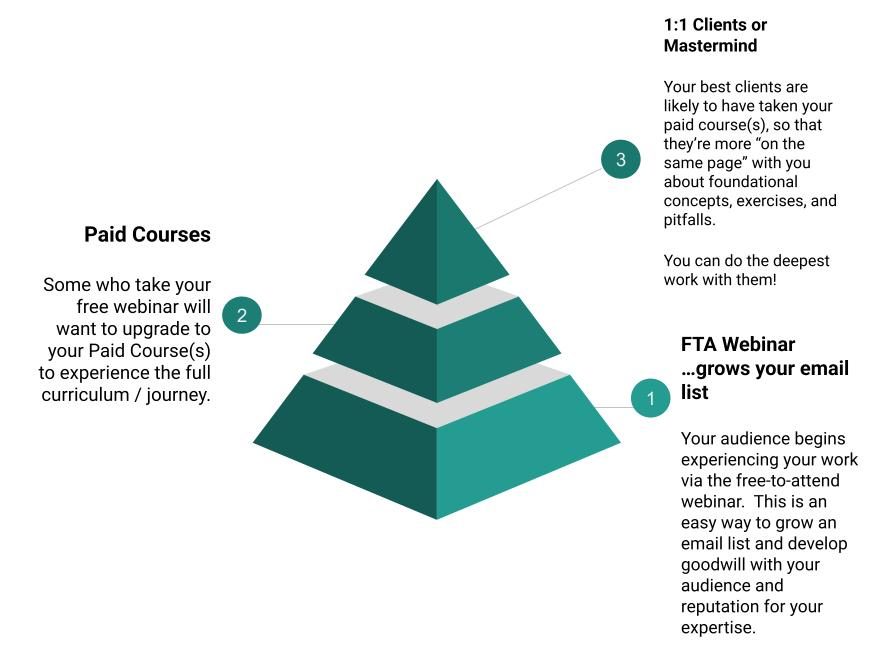
Explanation of the Flowchart:
- FTA Webinar (Base of the Pyramid): This is the entry point. People discover your webinar through your promotional efforts (social media, email, etc.) and register for free. This grows your email list and introduces them to your expertise.
- Paid Course(s) (Middle of the Pyramid): A percentage of those who attend the FTA webinar (or watch the limited-time replay) will be interested in going deeper and will enroll in your paid course. The FTA webinar acts as a powerful "taster" and builds trust.
- 1:1 Clients or Mastermind (Top of the Pyramid): Your best clients often come from those who have already experienced your teaching through your courses. They're "on the same page" with your foundational concepts and are ready for more in-depth, personalized work.
Share in the Student Discussion doc -- what are your thoughts about the FTA Webinar strategy? Could you see yourself applying this in your business?
George's answers to students' questions (click to show)
A student shared: "I m going to use all your formats for my first course, George, and get experience from it. 180euro, 5-6 modules, 1 FTA, recorded segments. I ll just add a Signal group for participants to share videos of their tennis issues, so they can get feedbacks there, easier than platforms like Simplero I believe. looking forward to the rest of the course! And wondering when I launch mine…🤔"
George replied: great!
As for timing... by Module 3, students announce their FTA webinar, so that such webinars can take place 2 weeks later. So if you're following along with the course, you could start your course a few weeks after Module 3.
A student shared: "Hi , I've already created a self-paced course that's meant to give a brief introduction and mini experience of my flow, write, rewire framework before they attend a live group session that goes much deeper into the framework. This live group session is included as part of the course fee. I'm wondering if I can teach my course material in an FTA webinar, and if they want, they can purchase …"
George replied: It's great to have you on this journey with us!
Sounds like you haven't yet tried the FTA webinar strategy with this new course material you've created? If not I recommend that you try it and see how the webinar signups go. I've been getting 25-35% webinar attendance from those who signed up, then from the webinar attendees I've gotten about 25-50% who then signup for the paid course.
As for creating a group program with specific goals -- that honestly sounds like an intriguing option too. Perhaps you can try it as a light launch sometime and see how the registrations go, compared to your FTA strategy.
A student shared: "I think it is applicable to my business. I need some more market validation that my topics are hitting the mark better, but that is the plan. Draft page is here. [link removed]"
George replied: at first glance, nice page!
a couple quick suggestions:
- You're great on video, so consider making a short 30-90 second video for this page to give people a feel for your energy.
- The pop-up opt-in box feels a bit too "easy" to sign up... it's more a newsletter opt-in than the feeling of "I want the right kind of person joining" so maybe consider adding a question to add a bit more seriousness to it... "What interests you about this webinar?" or "What question would you most like this webinar to answer for you?"...something like that.
- The "Submit" button feels a bit too loud... could you change the word to "Sign up" or "Confirm"?
Always offer freebie before selling a course? Not necessary.
Video · 4 min
"Do you always offer a freebie (a webinar or download) as a lead-in to signing up for a course?"
Key points from the video
- Answers a student's question: no, a freebie/FTA/lead magnet is not required before selling a course.
- George estimates that at least half of his courses since 2009 (dozens sold, probably well over 100 launched total) sold successfully with NO free webinar or download at all — simple announce-and-sell: announce ~2 weeks out, offer an early-bird price window, then regular price once the course starts; buyers just pay, with no free webinar or download beforehand.
- Why this works for him: years of built-up trust from content and podcast appearances means his audience is already primed to buy before any specific lead-in.
- Advice: start building a social media audience as soon as possible; it's never too early, and it's not too late either — though timing still matters (starting the same month you launch is probably too late; building for about 2 months ahead of a launch planned about 3 months out is reasonable, though he doesn't guarantee it will go well). Trust-account metaphor: you build trust by depositing into it, so start depositing today.
- Nuance from his own testing: FTA webinars sell better when built as a genuine module-one of the paid course, not a standalone webinar followed by an unrelated pitch — he tried the standalone approach, selling something that wasn't the course's second module, and it did not go well; with the webinar serving as module one of a four- or six-module course, it sells much better.
- Bottom line: the freebie/FTA approach is valuable (builds list, audience, and eases the sale) but is optional if you already have sufficient trust with your audience.
George's answers to students' questions (click to show)
A student shared: "I wonder about the pro's and con's of presenting the first module in the FTA webinar vs. an overview presentation answering "the 3 things" questions you encouraged us to ask ourselves. I fear the first module could benefit from a context setting overview webinar as opposed to diving into the first module. But I could be convinced otherwise..."
George replied: YES good point. The FTA webinar could be a really intriguing overview. As long as it does a good job of setting context and building motivation for the rest of the course, it's a good FTA :)
Brainstorm Your FTA Topics
Video · 8 min
Key points from the video
- Live brainstorm invitation for one-hour FTA/free webinar topics, with two named generation frameworks:
- "First module approach" (his current method): plan a rough outline of the FULL paid course first (his paid courses run 6 modules), then the FTA topic = whatever module one naturally is. The full outline can still shift after the webinar is taught, based on live student feedback/questions. Module-one content guidance: should be introductory, give context/roadmap for the rest of the course, include easy-win/low-hanging-fruit exercises so students feel real progress, bust a myth or two about the topic, and optionally include a (short) personal story — all in service of inspiring students to continue, not covering everything.
- "Foundation builder approach" / "foundational concepts approach": may stand alone rather than being course module-one. Exercise: picture your ideal client and what they typically already have (life experience, some skills) versus what they're missing or misconceive that would let deeper work happen faster together. Ask: what could you teach them in one hour that sets a stronger foundation for future 1:1 or small-group work, so early paid sessions aren't spent on basics? Can become a whole series of foundational webinars over time, leaving clients better prepared and you feeling more empowered as a service provider.
- Tradeoffs: the first-module approach transitions seamlessly into the paid course and lets you "double-dip" on content creation, but requires having a rough full-course outline first and the webinar must stand on its own even for non-upgraders; the foundation-builder approach is more flexible (no course required yet, can promote any service) but needs careful planning so it still clearly demonstrates your expertise.
- Regardless of approach, a strong FTA webinar should do three things: give clarity on key concepts (lay groundwork for deeper understanding), include quick-win exercises participants do live for an immediate taste of your method, and serve as a "map" of your work — an overview of your approach and the problems you solve, with the full course as the detailed guide to navigate that map.
The full lesson text (click to show)
This lesson will guide you through brainstorming potential topics for your own Free-To-Attend (FTA) webinar.
The goal of an FTA webinar is to provide genuine value, build your audience, and seamlessly lead into a paid offering (a full course or other services).
Two Approaches to FTA Topic Selection:
There are two primary ways to approach choosing your FTA webinar topic:
- The "First Module" Approach: Your FTA webinar could act as the first module (or a significant portion of the first module) of a larger, paid course. This is the approach we've been using in this very course.
- Benefits:
- Seamless transition to the paid course.
- Provides a substantial taste of the course content.
- Allows you to "double-dip" on content creation (the webinar becomes part of the course).
- Considerations:
- You need some idea of your full course's outline before creating the FTA webinar.
- The webinar must be valuable enough on its own, even if attendees don't join the full course.
- The "Foundational Concepts" Approach: Alternatively, your FTA webinar could focus instead on educating potential clients about the value and power of your work, even if it's not directly part of a specific course.
- Benefits:
- More flexibility in topic selection.
- Can be used to promote a wider range of services (not just courses).
- Good for those who don't yet have a full course planned.
- Consideration:
- Requires careful planning to ensure the webinar clearly demonstrates your expertise and the benefits of working with you.
Regardless of the approach you choose, your FTA webinar should:
- Provide Clarity on Key Concepts: Introduce and explain fundamental ideas, terms, or principles related to your area of expertise. Think of it as laying the groundwork for deeper understanding.
- Include Quick-Win Exercises: Offer practical, actionable exercises or activities that participants can do during the webinar to experience a small taste of your methods and the potential results. These exercises should be engaging and provide immediate value.
- Serve as a "Map" to Your Work: The webinar should give attendees a clear overview of your approach, your philosophy, and the types of problems you solve. Think of it as a "map" to the larger landscape of your work, with the full course (or your services) providing the detailed guidance and support to navigate that map.
Brainstorming Prompts:
Use the following prompts to brainstorm potential FTA webinar topics. Consider both the "First Module" and "Foundation Builder" approaches:
For the "First Module" Approach (If you have a course in mind) --
- What's the overall goal of your full course? What transformation will students experience?
- What are the first important foundational concept(s) students need to understand to succeed in your course? This could be a key principle, a common misconception, or a core skill.
- What's a simple exercise you could guide participants through that would demonstrate the power of your approach?
- What's the biggest "aha" moment you want students to have in the first module of your course? Can you create that "aha" moment in the FTA webinar?
- What are the key steps of your full course? You'll give them that overview by the end of the first module.
For the "Foundational Concepts" Approach (If you're focusing on your overall work) --
- What's the biggest problem you solve for your clients (or audience)?
- What's the most common misconception people have about your field or your approach?
- What's a simple, actionable tip or strategy you could share that would provide immediate value?
- What's a key concept or principle that underpins your work?
- What's a quick exercise you could lead participants through that would demonstrate the power of your methods?
Action Step:
- Brainstorm: Spend at least 15-20 minutes brainstorming potential FTA webinar topics, using the prompts above.
- Choose 2-3 Top Ideas: Narrow down your list to 2-3 topics that you feel most excited about and that you believe would be most valuable to your audience.
- Share in the Student Discussion doc: Share your top 2-3 FTA webinar topic ideas. Briefly explain:
- Which approach you're leaning towards ("First Module" or "Foundation Builder").
- Why you think this topic would be effective.
Let's generate some great FTA webinar ideas!
NOTE -- in the upcoming modules of this course you'll get more support in creating course topics and FTA topics. This page is an initial exercise only... so be sure to work lightly ✨😊
George's answers to students' questions (click to show)
A student shared: "I asked AI to help me ha! The goal of Feel Lighter, Move Freer is to help sensitive, empathetic people who feel weighed down by the world reconnect with their inner wisdom, emotional lightness, and embodied clarity—so they can move forward in life with more calm, confidence, and soul-led direction. Foundational concepts: - your body stores emotional and energetic information - it's hard to …"
George replied: that's great! You're ahead of the game. We're going to circle back to deciding on FTA topic later, but you've already got a good foundation!
A student shared: "I like the Foundation Builder approach a bit better. #### The 3 Keys to Plugging into Purpose at Work --- Discover the 3 Essential Principles to Help You Find Deeper Purpose at Work, Help Your Company Win in the Marketplace as You Deliver Positive Impact to the World. ###### Key #1 Deeper purpose is critical to both personal satisfaction and a thriving world. In business, purpose is the seed. …"
George replied: well done!
Love that you already have a metaphor e.g. fruit.
One thing that I wonder though -- "the impact they deliver is the fruit" -- is true for NPOs but if you're speaking to for-profit folks the fruit is the profit?
Call it a webinar or a workshop or something else?
Video · 2 min
Key points from the video
- A student's question: what to call the live event — webinar, workshop, journey, experience, play shop, etc.
- George's answer: don't decide it yourself — ask your audience. Method: brainstorm many candidate words (optionally with AI or a thesaurus, or by noticing what colleagues call similar things), sleep on the list, narrow to your favorite 3–5, then poll your audience on which sounds most valuable/enticing/most likely to make them sign up.
- Caveat: the word must match the actual experience (you technically could call a straight lecture a "workshop," but there's a connotation-mismatch risk) — follow the poll by asking people what they'd expect to happen in that kind of session, to confirm alignment before locking in the name.
What about a 3-hour paid webinar? (Tomar Levine)
Video · 6 min
Key points from the video
- Live coaching dialogue: Tomar is considering a monthly 3-hour paid workshop (with a break and exercises), partly to warm up to teaching a longer course and partly to build interest — but worries about redundant content when she later offers a 6-week course covering similar ground.
- George's key distinction: free vs. paid isn't inherently about lecture vs. experiential — a one-hour webinar CAN be experiential too. The real question is what you give away for free vs. what you charge for; experiential content generally reads as higher value regardless of price, and he says shorter events tend to draw more attendees.
- Mentions having seen (and personally attended) free, highly experiential 3-hour/3-day events used as lead-ins to high-ticket offers (e.g., $10k programs) — most attendees don't upgrade, but enough do to make it worthwhile; contrasts this with the hard-sell pattern he dislikes, where a Saturday-afternoon pitch has you write a big number such as $30,000 on paper, scratch it out, and act today only.
- Resolution for Tomar: go ahead with the 3-hour paid workshop she's already drawn to, but ALSO test a 1-hour version to compare attendance and signal — and to compare fairly, both versions should be paid (a free version would confound the comparison).
- Reinforces that making an FTA webinar the literal first module of her eventual six-week course would eliminate the content-redundancy worry, since that material is already built into the course rather than a separate overlapping offer.
George's answers to students' questions (click to show)
A student shared: "It’s really helpful to know that longer isn’t better and the longer it is, the lower enrollment. I offer what I call a three-hour “retreat” — Deep Magic Group. It’s absolutely the most advanced spiritual process I offer, and it’s a jewel of an experience! It’s hard to explain so I created an entire website just for the one class at www.deepmagicgroup.com. Despite the fact that people who try it, …"
George replied: just want to say, beautiful page and offering!
George added: I wonder if you have considered adding a video of yourself (to the page) talking sincerely about the experience... and even better if possible, having a few others who have taken part in the experience, talk about it on video too 🤩
A student shared: "Deep Magic Group sounds absolutely amazing! The work you do in that course sounds so valuable and rare. Is it possible that you need a gateway course to introduce yourself and your work instead of making your advanced class less... advanced? I'm asking because I did a lot of work making my deepest work more accessible last year. My offering was very popular, but I discovered that not …"
George replied: I agree!
Also, enrollment even for deep programs will become easier as our audience grows over time ✨
Overview of the pacing of a course launch and prep
Video · 14 min
Key points from the video
- Full launch timeline. Big picture: from having the seed of an idea to teaching the webinar/module-one = 4 weeks for George.
- Why 4 weeks specifically: he budgets only ~1 hour/week on launch logistics (would only need 2 weeks if he gave it 3–4 hrs/week); 4 weeks ≈ 4 hours of logistics spread out, layered on top of a 2-week marketing window.
- Marketing-length guidance: 2 weeks is his tested "sweet spot" for marketing a launch — 4 weeks risks both audience fatigue and his own fatigue.
- Module cadence: default is one module per week, aiming to wrap the whole course in about 6 weeks — modules CAN be spaced further apart, but risk students losing motivation or getting "shiny object syndrome" and drifting to another course. Exception: he sometimes leaves a 1-week break between module one (FTA webinar) and module two, since that week doubles as marketing time (encouraging people to sign up and catch up on the recording before module two).
- Detailed week-by-week logistics (working backward from week 0 = teaching week):
- Week -4: has the idea; plans the initial full-course outline (so he knows the module-one/FTA topic).
- Week -3: technical setup (Zoom link, registration page); drafts a short webinar description (1–2 inspirational paragraphs + bullet list of what's covered + note about the 72-hour replay); sends the description to a few supportive friends/colleagues/clients for feedback; also schedules reminder emails for registrants.
- Week -2: finalizes the registration page using feedback received; begins promoting the registration page everywhere (social media, etc.).
- Week -1: drafts the sales page for the full paid course (using the full-course outline as the basis; leans heavily on AI to speed drafting); sends the sales page out for feedback; sets up a bare-bones (no graphics yet) sales page live.
- Week 0: teaches the FTA webinar; uploads the recording; polishes the sales page (adds AI-generated graphics, etc.); sends the sales page to webinar attendees, telling them the replay is available for 72 hours and that the full course includes lifetime access.
- Per-module prep: 3–4 hours to prepare each module; each module = 1–2 hours of live teaching, split into two live sessions. Origin of the two-session format: originally taught 1-hour sessions but consistently ran long because he always had more to say, so he added a second evening session — partly to cover other time zones (Australia, Asia) and partly to finish material from session one without overwhelming people in a single sitting. Session 1 = teach as much as possible without overwhelming; Session 2 = wrap up remaining material + take questions.
- Notes AI has made his prep both faster AND more comprehensive than 2–3 years ago — feels like having a collaborator/tutor rather than working alone.
- Why he teaches live instead of solo pre-recording: recording alone turns him into a perfectionist who restarts repeatedly over small flubs (e.g., quitting 15 minutes in); being with a live audience and seeing faces keeps him going through the occasional false start. Records live sessions in segments and uploads them afterward (a literal walkthrough of his upload process is promised later in the course).
The full lesson text (click to show)
This lesson provides a high-level overview of the typical timeline I (George Kao) use for launching and preparing my courses. This is intended to give you a general framework. The remaining modules of this course will delve into each of these steps in much greater detail, providing templates, examples, and support.
The FTA Webinar: The Starting Point
The Free-To-Attend (FTA) webinar, which often serves as the first module of a full course, is the first major public-facing event in the launch process. However, significant preparation happens before the FTA webinar takes place.
The Timeline (Working Backwards from the FTA Webinar):
Here's a breakdown of the key activities and their approximate timing, working backward from the FTA webinar date (Week 0):
- 4 Weeks Before FTA Webinar (Week -4):
- Big Picture Planning:
- Decide on the overall topic of your full course. This provides the context for your FTA webinar.
- Based on the full course topic, determine the specific topic of your FTA webinar -- remember, it will be the first module of the full course.
- Time Commitment: Approximately 1 hour.
- 3 Weeks Before FTA Webinar (Week -3):
- Technical Setup & Initial Description:
- Set up the Zoom link (or your chosen webinar platform) for the FTA webinar.
- Create the webinar opt-in/registration page. This includes drafting a compelling description of the FTA webinar.
- Set up the automated reminder emails that will be sent to those who register for the webinar.
- Send the draft to friends/colleagues for review.
- (We will be covering all of this in detail, along with templates you can use, in the upcoming modules of the Course Creator's Journey.)
- Time Commitment: Approximately 1 hour.
- 2 Weeks Before FTA Webinar (Week -2):
- Promotion & Full Course Description:
- Finalize the webinar opt-in page based on feedback received.
- Begin promoting the FTA webinar everywhere you can:
- Your email list
- Social media channels
- Relevant online communities
- Reach out to colleagues for promotional support (if appropriate).
- Draft the description for your full course. This is important to have ready, even though you won't be actively promoting it yet. Send the draft out for feedback.
- Time Commitment: Approximately 1 hour per week (but promotion can take additional time).
- 1 Week Before FTA Webinar (Week -1):
- Sales Page & FTA Content Prep:
- Set up the sales page for your full course, incorporating feedback on the description.
- Prepare the content of your FTA webinar. This includes outlining the presentation, creating slides (if using), and practicing your delivery.
- Create the follow-up emails that will be sent after the FTA webinar, including:
- Thank you email with a link to the replay (if offering).
- Information about the full course and how to enroll (including any early-bird offers).
- Time Commitment: Approximately 1 hour per week (plus time for content preparation, which will vary). Work lightly ✨
- Week of FTA Webinar (Week 0):
- Delivery & Enrollment:
- Deliver the FTA webinar! Be engaging, provide value, and most importantly, have fun 😄
- At the end of the webinar, clearly mention the full course and invite attendees to enroll.
- Answer questions and engage with attendees.
- Send out the follow-up emails. (I'll provide you with email templates in an upcoming module of the course.)
- Time Commitment: Varies depending on webinar length and follow-up activities.
Key Takeaways:
- Planning is Crucial: The success of your course launch depends heavily on the preparation done before the FTA webinar.
- Iterative Process: The timeline involves refining your messaging and materials based on feedback.
- Consistent Effort: While the time commitment per week might seem small initially, it's important to dedicate consistent effort to each stage of the process.
- The FTA is Just the Start: This only talks about up until delivering the FTA.
The Upcoming Modules:
The subsequent modules of this course will break down each of these steps in detail, providing you with:
- Specific strategies for each stage of the process.
- Templates for opt-in pages, sales pages, emails, and more.
- Guidance on creating engaging webinar content.
- Support and encouragement from fellow course creators in the Student Discussion doc.
This overview provides the "big picture." Now, you will be ready to dive into the specifics!
What if I don't have an audience at all?
Video · 5 min
Key points from the video
- Directly answers the worry of starting from scratch with no audience. Core reframe: everybody has an audience; from the day you were born, you had one — your mother (and hopefully your father).
- Live back-and-forth with a participant who feels they have no audience because they have been disconnected from people for a long time — George gently draws out that they DO know a small group of people from other classes they've taken, and reframes that as the literal start of an audience.
- Statistical framing (he cites it loosely as scientific research): people know roughly 150 others by first name on average (range noted: some as few as 15, some as many as 1,500) — so even one supportive connection could plausibly yield several students (conservative estimate: out of ~50 people a connection knows, maybe 5–15 might be a fit for your course).
- Key idea: an audience begins with just one other person who supports you — busts the myth that having an audience means owning a 5,000-person email list.
- Practical exercise: start writing an actual list of everyone supportive of you — classmates (including from this very course), friends, colleagues, neighbors, family — each name potentially representing 5–50 future students.
- Advice to start building a social media audience today regardless of platform — it's never too late or too early. Pick any platform you don't mind using (he offers LinkedIn, Substack, TikTok and Blue Sky as alternatives if you dislike the Meta platforms), and directly ask your existing supportive network to follow/like as you begin.
George's answers to students' questions (click to show)
A student shared: "I don't disagree with your math when it comes to finding contacts who might constitute an audience, but determining who is "right" for the course is a much smaller number, and then those who would really pay for something from you is even smaller still. And you have mentioned in previous videos that friends and family often just give a throw-away like "it looks great!" and not helpful feedback."
George replied: great points! This is why in the early days / before our audience is big enough, we need to rely on things like (1) asking our network to share the FTA, (2) running ads, (3) creating content that resonates and spreads.
I am pivoting to a new niche, how to announce my new course to my audience?
Video · 4 min
Key points from the video
- Anonymous question: how to introduce a new course/niche when the audience is used to a different topic (example given: pivoting from relationships with other people to one's relationship to oneself).
- George's read: this particular pivot isn't really a niche change at all — it's the same broad territory (personal development), not that different — and he's puzzled why the person is worried; concludes the two topics are definitely related enough, so just go do it, no content run-up needed.
- General rule offered via exaggerated contrast examples: genuinely disparate pivots (his own facetious examples: relationships with other people → knitting; spiritual topics → a specific technical software; energy body healing → iPhone software; helping people get promoted → training a dog) DO warrant building some new content first (at least a month or two) before selling in the new area — unless you can bridge the two with a clever connecting story (his own playful improvised bridges: weaving knitting into relationship-building; framing dog training as parallel to training your boss for a promotion).
- Bottom line: a pivot within the same broad territory (e.g., anything under "personal development") needs no separate ramp-up content and no worry at all; only a genuinely unrelated pivot benefits from some pre-content and/or a bridging narrative.
After you watch
If you’d like more after watching: The Course Creator’s Journey course. If you buy the course, this module comes with it, along with all the others, and you keep them for life.
This replay has closed
Thank you for signing up to watch.
If you’d like to keep going, the complete Course Creator’s Journey course is available for enrollment: The Course Creator’s Journey course. If you buy the course, this module comes with it, along with all the others, and you keep them for life.